
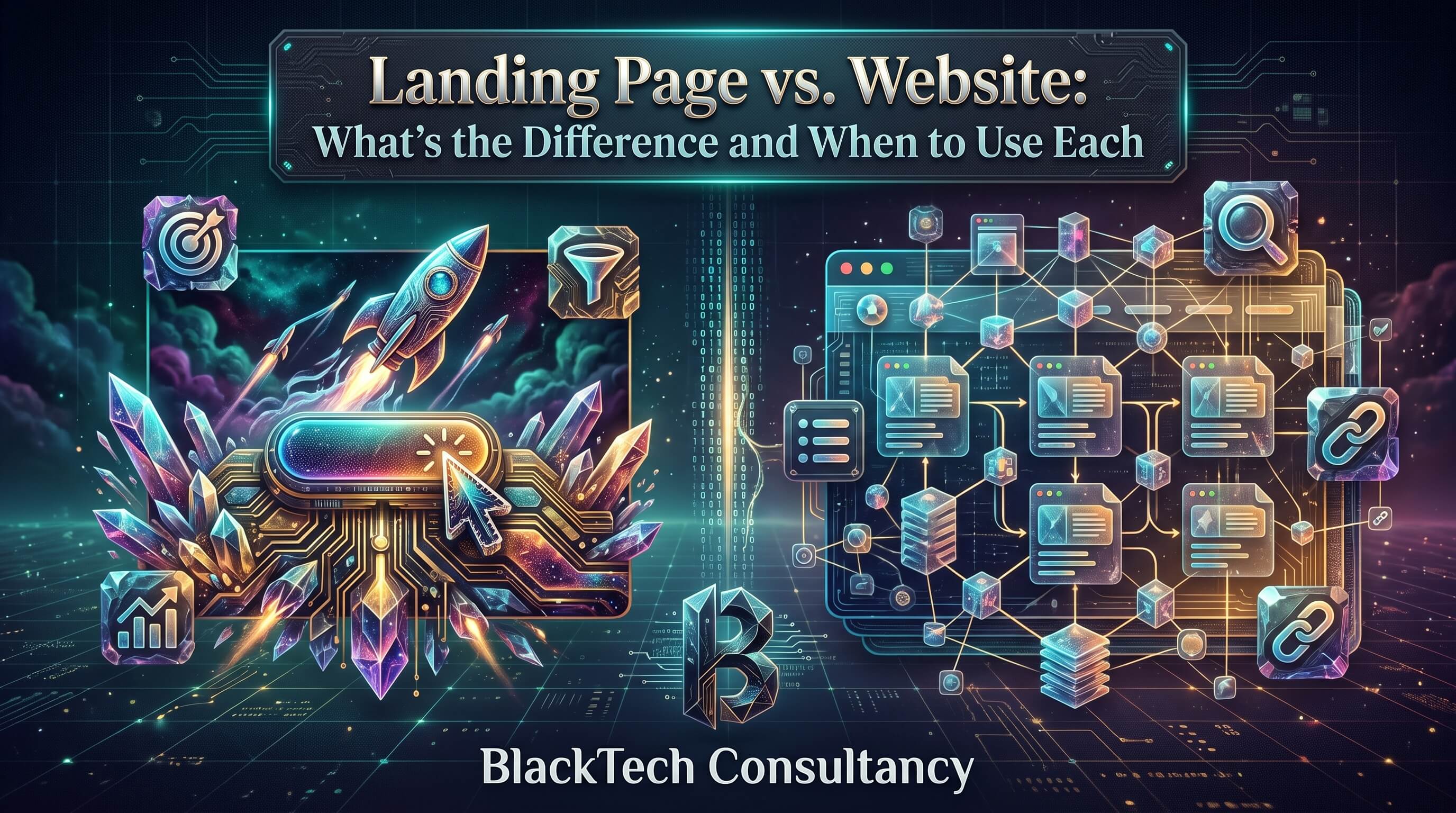
Every business that markets online eventually runs into the same question: should this campaign point to a landing page, or should it live on the main website? The two terms get used interchangeably by people who haven't built either, but they serve very different purposes, follow different design rules, and drive different results. Choosing wrong doesn't just waste a little effort — it can quietly sabotage an entire ad campaign, a product launch, or a lead-generation push.
This guide breaks down exactly what separates a landing page from a website, walks through the practical scenarios where each one wins, and gives you a framework for deciding which to build the next time a marketing idea lands on your desk. Whether you're a small business owner mapping out your first digital strategy or a marketing manager trying to justify a new campaign structure to leadership, this comparison will give you the clarity to move forward with confidence.
What Is a Website?
A website is the digital headquarters of a business. It's a collection of interconnected pages — typically including a homepage, an about page, service or product pages, a blog, contact information, and often a portfolio or resources section — all tied together through navigation menus, internal links, and a consistent brand identity. A website exists to represent the full scope of what an organization does, who it serves, and why it can be trusted.
Because a website covers so much ground, it's built for exploration. Visitors arrive with different intentions: some want pricing, others want to read case studies, and some are simply curious about the company culture before applying for a job. Good website architecture anticipates all of these paths and gives each visitor a way to self-navigate toward the information that matters to them.
A website also functions as a long-term asset. Unlike a single campaign page, it accumulates authority over time through search engine indexing, backlinks, and content depth. Search engines crawl every page, evaluate the relationships between them, and use that structure to understand what the business does and how trustworthy it is. This is why a well-maintained website tends to become a company's strongest organic traffic source over months and years, even without paid advertising.
In short, a website is built for breadth, credibility, and longevity. It answers the question "who are you, and what can you do for me, in every possible way I might ask it?"
What Is a Landing Page?
A landing page, by contrast, is a single, standalone page built around one specific goal. It could be built to capture email sign-ups, sell one product, promote a webinar, or convert visitors from a Google Ads or Facebook Ads campaign. Unlike a website, a landing page typically has no main navigation menu, no distracting links, and no competing calls to action. Every sentence, image, and button on the page exists to move the visitor toward a single conversion action.
This narrow focus is precisely what makes landing pages so effective for paid campaigns. When someone clicks an ad promising "50% off your first month," sending them to a general homepage forces them to hunt for that offer, and most visitors won't bother. A dedicated landing page, however, restates the exact promise from the ad, removes every other option, and asks for one clear action — sign up, buy now, or book a call.
Landing pages are also inherently temporary or campaign-specific by nature, even though many stay live indefinitely. They're built to match a particular audience segment, a particular offer, or a particular stage of the buyer's journey. A single business might run a dozen different landing pages simultaneously, each tailored to a different keyword group, ad set, or audience persona, while still maintaining just one core website.
Where a website answers many questions, a landing page answers one question extremely well: "why should I take this specific action right now?"
Landing Page vs. Website: Key Differences at a Glance
Seeing the two side by side makes the distinction much easier to internalize. The table below compares landing pages and websites across the factors that matter most when deciding which one a given project actually needs.
| Factor | Landing Page | Website |
|---|---|---|
| Primary Goal | One specific conversion action | Broad brand representation and multiple goals |
| Number of Pages | Usually one, self-contained | Multiple, interlinked pages |
| Navigation Menu | Minimal or none | Full menu with multiple sections |
| Traffic Source | Paid ads, email campaigns, social promotions | Organic search, referrals, direct visits, ads |
| Lifespan | Campaign-specific, often short to mid-term | Long-term, ongoing asset |
| SEO Role | Minor, unless specifically optimized | Central pillar of organic search strategy |
| Conversion Rate | Typically higher due to focused message | Typically lower due to broader intent mix |
| Build Time | Hours to a few days | Weeks to months, depending on scope |
| Best Used For | Campaigns, promotions, lead generation | Brand authority, trust-building, long-term growth |
Purpose and Goals: Why the Distinction Matters
The core difference between a landing page and a website isn't really about design — it's about intent. A website is meant to serve every visitor who might land on it, regardless of where they came from or what stage of the buying process they're in. That means it has to accommodate first-time visitors who know nothing about the company, returning customers looking for support, job seekers, journalists, and potential partners all at once.
A landing page, on the other hand, is built with foreknowledge of exactly who is going to see it and why. If it's linked from a Google Ads campaign targeting "emergency plumber near me," the page can be built entirely around urgency, local trust signals, and a click-to-call button, without worrying about explaining the company's full service catalog. That specificity is what makes landing pages convert so much better than general pages for paid traffic — research from major conversion optimization platforms consistently shows that dedicated landing pages outperform homepages for ad-driven traffic because the message matches the visitor's exact expectation.
This mismatch between intent and destination is one of the most common and costly mistakes in digital marketing. Sending highly qualified, ready-to-buy traffic to a generic homepage forces that visitor to do extra work to find what they were promised, and every extra click or scroll is an opportunity to lose them. A landing page removes that friction entirely by matching the page content to the exact promise made in the ad or email that brought the visitor there.
Design and Structure Differences
The structural choices behind a landing page and a website reflect their different goals. A website's design has to support wayfinding. Visitors need a clear main menu, a search function on larger sites, footer links, and breadcrumb trails so they can move fluidly between sections without feeling lost. Because a website often needs to rank in search engines and support many types of content, its structure tends to be hierarchical — a homepage branching into category pages, which branch further into individual product or article pages.
A landing page strips almost all of that away. There's typically no header menu, no footer full of links, and no sidebar. Every design element exists to guide the eye downward, toward the call-to-action button, using visual hierarchy, whitespace, and persuasive copy blocks such as testimonials, benefit statements, and urgency cues. Distraction is treated as the enemy of conversion, so anything that doesn't support the single goal gets removed.
This difference also affects load speed and mobile responsiveness priorities. Because landing pages are often the direct destination of paid ad clicks — where every second of load time costs money — they're usually built lighter and faster than full websites, with fewer scripts, smaller image files, and a laser focus on above-the-fold clarity. A website, while it should certainly be fast, has more content to manage and therefore more technical complexity to balance.
Content Strategy: How Messaging Differs
Content on a website is written to inform, educate, and build long-term trust. Service pages explain what a company does in detail, blog posts answer common questions to attract organic search traffic, and about pages tell the founding story to build an emotional connection. The tone can vary by section, but the overall goal is comprehensive coverage of every relevant topic a potential customer or stakeholder might search for.
Content on a landing page is written to persuade, and it does so with ruthless economy. Every headline is tested against a single question: does this move the reader closer to converting? Landing page copy typically follows proven frameworks — a strong headline that mirrors the ad's promise, a subheadline that adds a benefit, a handful of scannable bullet points, social proof such as reviews or client logos, and a repeated call-to-action button throughout the page.
Because landing pages are usually A/B tested extensively, their content also evolves faster than website content. Marketers routinely test different headlines, button colors, testimonial placements, and even form field counts to squeeze out incremental conversion improvements. A website's core content, by comparison, tends to change more gradually, driven by SEO performance data, seasonal updates, and periodic rebrands rather than constant split-testing.
SEO, AEO, and GEO Considerations for Each
Search engine optimization plays very different roles depending on which asset you're building. A website is, almost by definition, the primary vehicle for organic search visibility. Its internal linking structure, keyword-targeted service pages, blog content, and technical SEO foundation all work together to help search engines understand the breadth of what a business offers and rank it accordingly. Answer Engine Optimization and Generative Engine Optimization — the practices of structuring content so AI-driven search tools and chat-based assistants can accurately summarize and cite it — also depend heavily on a website's depth of content, since these systems favor sources that thoroughly and clearly answer a topic across multiple interlinked pages.
Landing pages, by contrast, are rarely built with organic search as the primary goal, since they usually rely on paid traffic or direct links. That said, a landing page can still be optimized for search when it targets a specific, high-intent keyword phrase that a dedicated page can serve better than a general service page. In those cases, the same core SEO principles apply: a clear keyword-aligned title tag, a concise meta description, a single H1 that matches search intent, and fast load times.
The key distinction for search strategy is that a website earns rankings gradually through accumulated authority and content depth, while a landing page — if it ranks at all — usually does so because it precisely matches a narrow, specific query. Businesses that rely entirely on landing pages while neglecting their core website often find themselves with strong paid-traffic conversion rates but weak organic visibility, since there's no substantial content footprint for search engines to index and trust over time.
When to Use a Website
A website is the right choice whenever the goal is long-term brand building rather than a single campaign outcome. If you're establishing a new business and need a central hub that represents your full range of services, a website is non-negotiable — it's where potential customers, partners, investors, and even employees will go to validate that your business is real, credible, and worth engaging with.
A website also makes sense when your business has multiple products, services, or audience segments that each deserve their own dedicated page. Trying to cram that complexity into a single landing page would overwhelm visitors and dilute the focus that makes landing pages effective in the first place. Similarly, if organic search traffic is a meaningful part of your growth strategy, a website with a properly structured blog and service pages will consistently outperform any standalone landing page over time.
Finally, a website is essential if you need to support ongoing customer relationships after the initial conversion — things like account portals, support documentation, order tracking, or a resources library. These functions require the interconnected structure that only a full website can provide.
When to Use a Landing Page
A landing page earns its place any time you're running a specific, measurable campaign with one clear conversion goal. Paid advertising is the most obvious use case — whether it's Google Ads, Facebook Ads, LinkedIn Ads, or a sponsored email blast, sending that traffic to a dedicated landing page rather than a general website page consistently produces better conversion rates because the message stays perfectly aligned with what the visitor expected to see.
Product launches, limited-time promotions, webinar registrations, and lead-magnet downloads are also ideal landing page scenarios. In each case, you want to eliminate distractions and give the visitor exactly one path forward. A landing page is also the smarter choice when you're testing a new offer or messaging angle before committing it to your permanent website — since it's faster and cheaper to build, you can validate demand or refine your pitch without touching your core site architecture.
Local service businesses often benefit from location-specific or service-specific landing pages as well, particularly when running geo-targeted ad campaigns. A landing page built specifically for "emergency data recovery in Arlington, VA," for example, can speak directly to that local intent in a way a general services page cannot, boosting both relevance and conversion rate for that specific campaign.
Can a Landing Page and a Website Work Together?
Rather than treating landing page vs. website as an either-or decision, the strongest digital strategies treat them as complementary tools working toward the same business goals. A well-run business typically maintains one authoritative website as its long-term digital foundation, while spinning up multiple landing pages for specific campaigns, offers, or audience segments as needed.
In practice, this often looks like a main website that ranks organically for broad service terms and builds brand trust, paired with a rotating set of landing pages built for each new ad campaign, seasonal promotion, or lead-generation push. The landing pages can even link back to the main website for visitors who want to explore further after their initial interaction, creating a natural bridge between focused conversion and broader brand discovery.
This combined approach also makes performance tracking cleaner. Because each landing page is built around a single goal, it's far easier to measure exactly how a specific campaign performed compared to trying to isolate that data from a multi-purpose website page. Marketing teams can then take the lessons learned from high-performing landing pages — winning headlines, offer structures, or design patterns — and apply them back to the core website over time.
Cost, Time, and Resources: A Practical Comparison
Budget and timeline are often the deciding factors when a business has to choose between building a landing page or a full website, especially when resources are limited. The table below outlines what to typically expect for each option.
| Consideration | Landing Page | Website |
|---|---|---|
| Typical Build Time | A few hours to several days | Several weeks to a few months |
| Ongoing Maintenance | Low — occasional copy or offer updates | Higher — regular content, security, and technical upkeep |
| Skill Requirements | Copywriting, basic design, conversion testing | Web development, UX design, SEO, content strategy |
| Return on Investment Timeline | Fast — measurable within days of launch | Gradual — organic value builds over months |
| Scalability | Easy to duplicate and adapt for new campaigns | Requires planning to expand without disrupting structure |
Common Mistakes Businesses Make With Landing Pages and Websites
One of the most frequent errors is sending paid advertising traffic straight to a homepage instead of a dedicated landing page. This dilutes the ad's message, forces visitors to search for the offer, and almost always results in a lower conversion rate and a higher cost per acquisition than a properly matched landing page would produce.
Another common mistake is treating a landing page like a mini-website by adding a full navigation menu, multiple calls to action, and links to unrelated pages. The moment a visitor is given more than one path forward, the carefully built persuasion sequence starts to break down, and conversion rates tend to drop noticeably.
On the website side, businesses often make the opposite mistake — trying to make every page do too much. A homepage that attempts to sell five different services, capture email sign-ups, promote a webinar, and explain company history all at once ends up accomplishing none of those goals particularly well. Clear separation between the website's role as an information hub and a landing page's role as a conversion tool tends to solve most of these issues.
Neglecting mobile optimization is another shared pitfall. Since a significant share of both organic and paid traffic now arrives from mobile devices, any landing page or website that isn't fully responsive risks losing a large percentage of potential conversions before the visitor even reads the headline.
How to Decide: A Quick Framework
When faced with a new marketing project, a few simple questions can clarify whether a landing page or a website is the right build. Ask whether the traffic is coming from a specific, trackable campaign or from general brand awareness and organic search — campaign traffic favors a landing page, while broad discovery favors a website. Ask whether there's one clear action you want every visitor to take, or several different paths depending on who they are — a single action points to a landing page, while multiple paths point to a website section.
Consider timeline and budget as well. If a promotion needs to launch within days and has a limited testing budget, a landing page is almost always the more practical choice. If the goal is to build lasting authority in a competitive market over the next year, investing in a comprehensive website with strong content and technical SEO will pay off far more reliably.
For most growing businesses, the answer isn't choosing one over the other permanently — it's recognizing that both tools solve different problems, and building the right one for each specific goal as it arises.
Schedule An Appointment with BlackTech Consultancy
Deciding between a landing page and a full website — and then designing, building, and optimizing either one correctly — takes experience across web development, conversion copywriting, and search strategy. BlackTech Consultancy helps businesses map out the right digital structure for their goals, whether that means launching a high-converting campaign landing page, building a comprehensive website from the ground up, or combining both into a unified digital strategy.
BlackTech Consultancy
Virginia, United States
+1 571-478-2431
info@blacktechcorp.com
https://www.blacktechcorp.com/
Frequently Asked Questions
Is a landing page part of a website, or is it completely separate?
A landing page can technically live on the same domain as a website, but functionally it behaves as a standalone page. It usually skips the main navigation and internal links that connect the rest of the website, so visitors stay focused on a single conversion action instead of browsing further into the site.
Do I need both a landing page and a website for my business?
Most established businesses benefit from having both. A website builds long-term credibility and organic search visibility, while landing pages support specific campaigns, promotions, or lead-generation efforts. Relying on only one usually leaves a gap — either weak brand authority or poor campaign conversion rates.
Which converts better, a landing page or a website homepage?
For paid advertising and campaign-driven traffic, a dedicated landing page almost always converts better than a homepage because its message matches the visitor's exact expectation. A website homepage, however, is better suited for visitors who are still exploring and comparing options, since it offers broader information and navigation.
How much does it typically cost to build a landing page versus a full website?
A landing page is generally faster and less expensive to build since it's a single page focused on one goal, while a full website requires more time, content, and technical planning due to its multiple interconnected pages. Exact costs vary widely depending on design complexity, features, and whether custom development is involved, so it's best to request a tailored quote based on your specific goals.
Can a landing page rank on Google the same way a website page can?
A landing page can rank for specific, well-targeted keywords if it's properly optimized with the right title tag, meta description, and content structure, but it typically won't build the same level of long-term organic authority as a full website. Websites tend to outperform landing pages in search visibility over time because of their depth of content and internal linking structure.