
A three-person plumbing company will never outrank a national home services brand for the word "plumber." It does not need to. The searcher typing "emergency water heater repair Fairfax VA Saturday" is worth more than a hundred vague visitors — and that is exactly the kind of query where small businesses consistently win.
Search has quietly split into two very different games. One game is fought over short, broad, expensive terms where budget and domain authority decide the winner. The other is fought over thousands of specific, intent-rich phrases where relevance, expertise, and speed matter far more than company size. Long-Tail Keywords sit at the center of that second game, and they have become the single most reliable growth lever available to businesses that cannot outspend the market leaders.
This guide breaks down what these phrases really are, why large competitors structurally struggle to defend them, how artificial intelligence has made them more valuable rather than less, and exactly how to build a long-tail program from scratch. Everything here is practical. By the end, you should be able to open a spreadsheet and start building a keyword map that actually produces revenue.
What Long-Tail Keywords Actually Are (And Why the Name Confuses People)
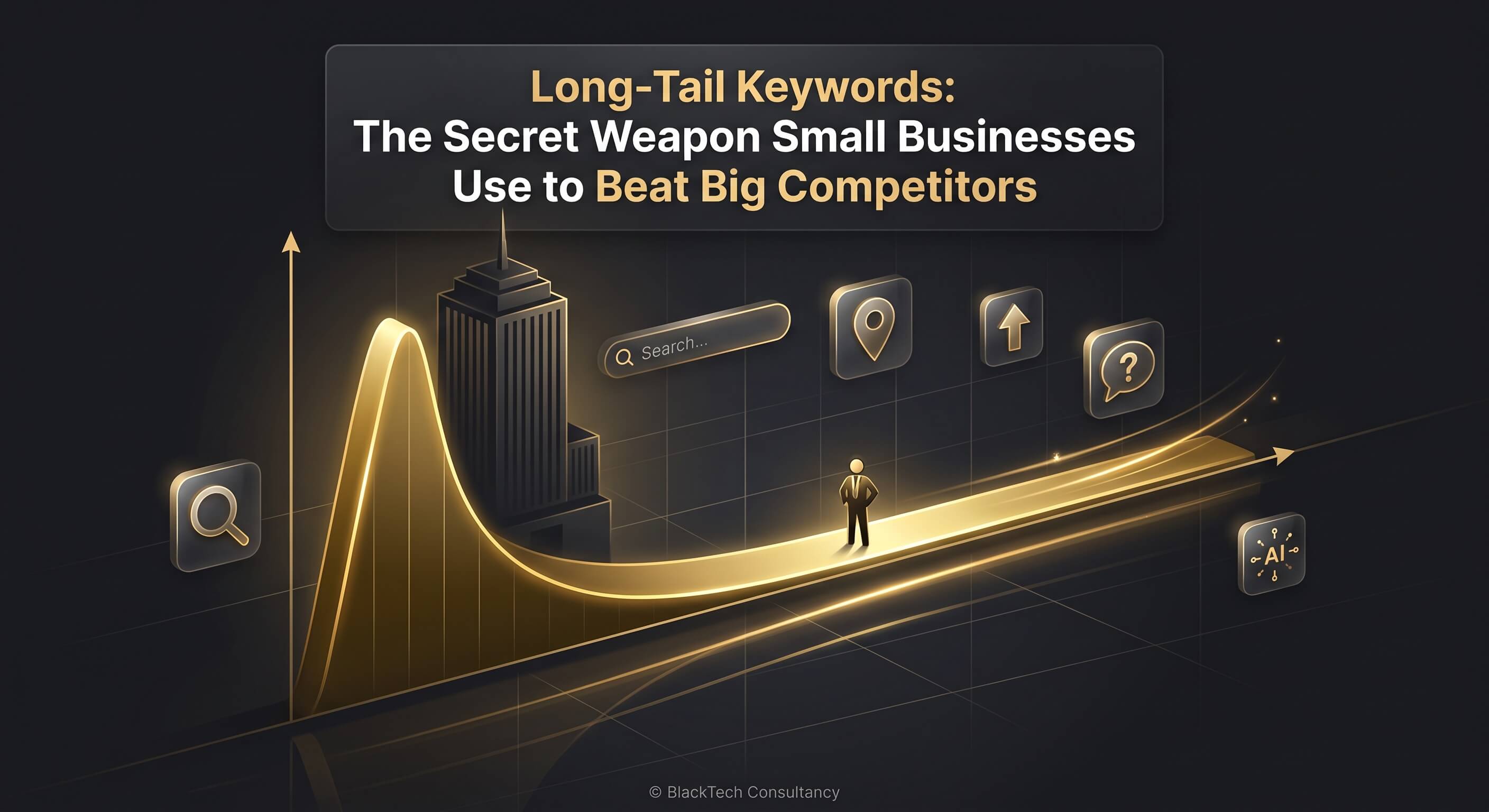
The term comes from statistics, not marketing. Plot every search query a market receives on a graph, ranked by monthly volume, and you get a curve with a tall, narrow head on the left and a very long, very flat tail stretching to the right. The head contains a handful of phrases that millions of people search. The tail contains millions of phrases that only a handful of people search. Add the tail up, however, and it dwarfs the head.
Most people assume "long-tail" simply means "a long phrase." That assumption is close, but it is not precise. Length is a symptom, not the definition. The defining characteristic is low individual search volume combined with high specificity. A five-word phrase that gets 40,000 searches a month is still a head term. A three-word phrase that gets 20 searches a month is still part of the tail.
Specificity is what makes these queries valuable. When somebody searches "shoes," nobody knows what they want — a repair shop, a history lesson, a shopping page, or a definition. When somebody searches "wide fit waterproof hiking boots for flat feet," their need is fully described. The query itself contains the product category, three qualifying attributes, and an implied purchase intent. There is no guesswork left.
The Three Tiers of Search Demand
Keyword strategy becomes much clearer once you stop thinking about individual phrases and start thinking in tiers. Each tier behaves differently in terms of competition, cost, and conversion, and each one deserves a different type of page.
| Tier | Example | Typical Volume | Competition | Realistic Owner |
|---|---|---|---|---|
| Head terms | "accounting software" | 50,000+ / month | Brutal | Funded brands, marketplaces |
| Body terms | "accounting software for nonprofits" | 1,000–10,000 / month | Moderate to high | Established niche players |
| Long tail | "accounting software for small nonprofits with grant tracking" | 10–200 / month | Low | Small businesses, specialists |
| Ultra long tail | "how do small nonprofits track restricted grant funds without QuickBooks" | Under 10 / month | Almost none | Anyone who answers it well |
Notice the pattern moving down the table. Volume falls, competition collapses, and the phrase itself gets closer to describing a real business problem. That trade is the entire strategic argument. You give up raw reach and receive qualified demand in exchange, and qualified demand is what pays salaries.
Why Large Competitors Struggle to Defend the Long Tail
Bigger companies are not lazy. They are constrained by their own operating model, and those constraints create openings that smaller teams can walk straight through.
The first constraint is economic. Large marketing departments measure content by projected traffic because their cost per page is high. When a page needs a brief, a writer, a legal reviewer, a brand reviewer, a designer, and a project manager, it may cost several thousand dollars to publish. A page targeting 30 searches a month cannot survive that math on a spreadsheet, even when it would close deals. So the query gets deprioritized, year after year, and the tail stays open.
The second constraint is structural. Enterprise websites are built around templates. Product pages, category pages, and location pages are generated at scale from a database, which is efficient but rigid. A customer asking a nuanced question about compatibility, edge-case pricing, or an unusual installation scenario does not fit that template. Small businesses have no such rigidity. They can publish a page about one specific problem on one specific afternoon.
The third constraint is speed. Approval chains slow enterprise publishing to a crawl. A regional supplier can spot a new question in a customer email on Monday and have a page answering it live by Wednesday. In fast-moving categories, that gap is decisive, because search engines and AI systems both reward the source that addressed a question first and most clearly.
The fourth constraint is credibility. Specific queries often demand lived expertise. A national franchise cannot write convincingly about the drainage quirks of a particular county's soil, or about which equipment fails most often in coastal humidity. A local operator can, and that specificity reads as genuine experience to both human readers and evaluation systems.
Key insight: You are not competing against a large brand's entire marketing budget. You are competing against the one page they allocated to a topic you have thirty pages on. Depth in a narrow area beats breadth in a wide one, every time, at the query level.
The Economics: Low Volume, High Revenue
The most common objection to a long-tail program is that the numbers look small. Thirty searches a month feels unserious next to a term with fifty thousand. That reaction misreads how the funnel actually works, so it helps to run the arithmetic honestly.
Broad terms attract mixed audiences. Students, competitors, job seekers, journalists, and casual browsers all use them. Specific terms filter that noise automatically. A visitor who typed a seven-word phrase describing their exact situation has already qualified themselves before landing on your page. Industry data consistently shows that specific queries convert at roughly two to three times the rate of broad ones, and anyone who has compared their own landing page reports will recognise the pattern.
| Scenario | Broad Term Strategy | Long-Tail Strategy |
|---|---|---|
| Keywords targeted | 1 term, 40,000 searches/month | 60 terms, 45 searches/month each |
| Realistic ranking position | Page 3–5 (if at all) | Positions 1–5 on most terms |
| Estimated monthly clicks | ~120 | ~810 |
| Conversion rate | 0.8% | 2.4% |
| Monthly leads generated | 1 | 19 |
| Time to first result | 12–24 months | 4–12 weeks |
The illustration above uses conservative assumptions, yet the gap is dramatic. Sixty modest pages outperform one ambitious page by a wide margin, and they do it far sooner. Cash flow matters enormously for smaller companies, so a strategy that produces leads in the first quarter rather than the second year is not merely more efficient — it is the only version that survives a budget review.
There is a compounding effect as well. Each new page strengthens topical authority around a subject area, which gradually lifts the performance of neighbouring pages. Twenty pages about commercial refrigeration make the twenty-first page rank faster than the first one did. This snowball is the reason patient publishers eventually start winning body terms they never directly targeted.
How AI Search Rewired the Value of Specific Queries
Generative search changed the landscape between 2024 and 2026, and a lot of commentary got the implications backwards. The common fear was that AI answers would kill organic traffic entirely. What actually happened was a redistribution: broad informational queries lost clicks to summaries, while specific queries became more valuable because they are harder to answer generically and more likely to require a cited source.
Two behavioural shifts drive this. First, conversational interfaces encourage people to write full sentences. Nobody types "shoes" into a chat assistant; they type a paragraph describing their foot shape, budget, and intended use. Second, assistants themselves decompose those paragraphs into multiple narrower searches behind the scenes. The result is that machine-mediated search has enormously increased the number of highly specific queries flowing through the system, even when a human never typed them into a search box.
Research from search visibility platforms shows that queries of eight or more words are dramatically more likely to trigger an AI-generated answer than short ones, and that this category has grown by several hundred percent since AI Overviews launched. In practice, that means the phrases small businesses have always been able to win are now the same phrases feeding AI systems their source material.
What AI Systems Actually Reward
Being cited in an AI answer follows a different logic from ranking first on a traditional results page. Language models assemble responses from passages, not whole documents. A page that contains one clearly labelled, self-contained passage answering a precise question is more citable than a rambling 5,000-word guide that buries the same answer in paragraph forty.
- Direct answers near the heading. State the answer in the first two sentences under a question-shaped subhead, then elaborate. Models extract the top of the passage.
- Consistent entity naming. Use the same product, service, and brand names throughout rather than varying them stylistically. Consistency helps systems connect your page to the right entity.
- Structured data. FAQ, Service, Product, LocalBusiness, and Article schema make relationships explicit rather than implied.
- Verifiable specifics. Numbers, dates, model names, dimensions, and named processes are extractable. Vague adjectives are not.
- Demonstrated experience. First-hand detail — what you observed, tested, or repaired — is the strongest differentiator against generic content.
Answer Engine Optimization and Generative Engine Optimization are simply names for shaping content this way. Neither replaces traditional SEO; both sit on top of it. A page built around Long-Tail Keywords with clean structure and honest expertise tends to satisfy classic ranking factors and generative citation criteria simultaneously, which is why the approach has aged so well.
The Four Intent Categories You Should Be Mapping
Not every specific phrase deserves the same treatment. Sorting by intent prevents the most common wasted effort in keyword work: building a sales page for a research query, or a blog post for someone holding a credit card.
| Intent Type | Query Signals | Right Page Format | Primary Goal |
|---|---|---|---|
| Informational | how, why, what, guide, meaning | Tutorial, explainer, FAQ hub | Trust and email capture |
| Commercial investigation | best, vs, alternative, review, comparison | Comparison table, buyer's guide | Shortlist inclusion |
| Transactional | buy, price, quote, hire, near me, book | Service or product landing page | Direct conversion |
| Problem-aware / support | not working, error, won't start, fix | Troubleshooting article | Urgent service enquiry |
The fourth row is routinely ignored and routinely the most profitable for service businesses. Somebody searching "furnace blowing cold air after filter change" has an active, uncomfortable problem. They are not researching a purchase next quarter. They need help today, and the business whose page explains the cause clearly usually gets the call.
Where to Find Long-Tail Keywords That Actually Exist
Keyword tools estimate. Real sources of demand tell you what people genuinely typed. Start with the sources that report reality, then use tools to expand and validate.
1. Mine Your Own Search Console Data First
Open the Performance report in Google Search Console, set the date range to the last twelve months, and export every query. Filter for phrases containing four or more words. You will typically find dozens of queries where your site already appears in positions eight to twenty with impressions but almost no clicks. Those are pages Google is willing to rank, held back only by insufficient focus. Writing a dedicated page for each one is the fastest win available in all of search marketing.
Pay particular attention to queries where you rank but have no matching page. That mismatch means a search engine guessed at your best available content. Give it a precise match instead and rankings usually improve within weeks.
2. Harvest Autocomplete, People Also Ask, and Related Searches
Type your core service into the search bar and record every autocomplete suggestion, then repeat by appending each letter of the alphabet. Expand every People Also Ask box; new questions load as you click, producing a tree that can run for dozens of entries. Scroll to related searches at the bottom of the page. These are not estimates — they reflect aggregated real behaviour, and they surface phrasing you would never have invented.
3. Read Your Customer Conversations
Sales emails, chat transcripts, quote request forms, and recorded calls are a keyword goldmine that no competitor can access. Customers describe problems in their own vocabulary, which is usually different from industry vocabulary. A contractor says "membrane roof"; a homeowner says "flat rubber roof leaking at the seam." Optimizing for the professional term and ignoring the customer term is one of the most expensive mistakes in technical industries.
Build a running document. Every time a prospect asks a question by phone or email, log the exact wording. Within two months you will have a publishing calendar written by your own market.
4. Study Community Platforms and Review Sites
Reddit threads, niche forums, Facebook groups, and question sections on retail listings are dense with unfiltered phrasing. Review sites are equally useful: one-star reviews of competitors describe unmet needs precisely, and two-star reviews of products reveal the comparison criteria buyers actually apply. Both translate directly into page topics.
5. Interrogate AI Assistants Like a Customer Would
Ask a conversational assistant the questions your customers ask, then examine which sources it cites. That citation list is a competitive map for generative visibility. If the same three competitors appear repeatedly, study how their pages are structured — headings, answer placement, schema — because those choices are what earned the citation.
Research Tools Worth Paying For (And What They Cost)
Tooling is helpful but not the bottleneck. Plenty of small businesses have built substantial organic programs using free data alone. That said, paid platforms save time on clustering, difficulty scoring, and competitive gap analysis. Prices below reflect published list rates during 2026 and change regularly, so verify on each vendor's own pricing page before committing.
| Tool | Best For | Entry Price (2026) | Notable Limitation |
|---|---|---|---|
| Google Search Console | Real queries your site already receives | Free | Only shows your own site |
| Google Keyword Planner | Volume ranges and commercial value | Free with Ads account | Groups similar terms, hides exact numbers |
| Semrush | All-in-one SEO, PPC and AI visibility | From about $139.95/month | Seat and add-on fees stack quickly |
| Ahrefs | Backlink depth and keyword discovery | Starter from $29, Lite from $129/month | Per-seat pricing since March 2026 |
| AnswerThePublic | Question-shaped query discovery | Limited free searches, paid tiers above | Thin volume and difficulty data |
| AlsoAsked | Mapping People Also Ask hierarchies | Free daily searches, low-cost plans | Single-purpose tool |
| Keywords Everywhere | Inline metrics while browsing | Credit-based, very low cost | Browser extension only |
| LowFruits | Finding weak competitors on niche terms | Pay-as-you-go credits | Narrow feature set |
A practical recommendation for a company spending under a thousand dollars monthly on marketing: start with the two free Google tools plus one inexpensive discovery tool. Upgrade to a full platform only once you have exhausted the opportunities already visible in your own data, which usually takes six months or more.
From Keyword List to Content Architecture
A spreadsheet of a thousand phrases is not a strategy. The next step is grouping them so that each page serves one clear purpose, which prevents the two most common structural failures: thin pages and keyword cannibalization.
Cluster by Answer, Not by Wording
Group phrases that share a single correct answer onto one page. "How much does commercial window tinting cost," "commercial window tint price per square foot," and "average cost to tint office windows" are three phrasings of one question. They belong on one thorough page, not three thin ones. Conversely, "cost to tint office windows" and "cost to remove old window tint" describe different jobs and need separate pages, however similar the wording appears.
The reliable test is simple: search each phrase and compare results. If the same pages rank for both, one page can serve both. If the results differ substantially, build two pages. Search engines have already done this classification work for you.
Build Hubs and Spokes
Organize clusters into hubs. A hub page covers a broad service area and links out to spoke pages covering each specific question, situation, or sub-service. Every spoke links back to the hub and sideways to closely related spokes. This structure distributes internal authority efficiently, makes crawling straightforward, and signals topical coverage, which is precisely what generative systems evaluate when deciding whether a site is a credible source on a subject.
Aim for roughly eight to twenty spokes per hub before starting a new hub. Fewer than eight rarely establishes depth; more than twenty usually indicates the hub should be split into two narrower topics.
Prioritize by Value, Not Volume
Score each cluster on three factors: how close the query is to a purchase, how realistically you can rank given current competition, and how much revenue a resulting customer generates. A cluster with 25 monthly searches leading to a $9,000 contract outranks a cluster with 900 searches leading to a $40 order every single time. Small businesses that sort their keyword sheet by search volume are optimizing the wrong column.
Writing Pages That Win Rankings and Citations
Execution separates programs that work from programs that stall. The page itself must be genuinely better at answering the question than anything currently ranking, and it must be structured so that both algorithms and skim-readers can extract the answer instantly.
Open by answering the question directly. Do not warm up with three paragraphs of context. Someone searching "why does my espresso machine leak from the bottom" should read the likely cause within the first thirty words. Depth belongs immediately after the answer, not before it.
Match the query's specificity in your headings. If the phrase includes a constraint — a material, a location, a budget range, a compatibility requirement — that constraint should appear in an H2 or H3, not merely in body text. Headings function as the map both readers and extraction systems follow.
Include details only a practitioner would know. Actual price ranges, typical timelines, the part number that usually fails, the permit a particular jurisdiction requires, the failure mode you see most often in winter. Generic content is now trivially cheap to produce, so the scarce asset is verified, specific, experience-based information. That scarcity is your advantage.
Add supporting structure. A comparison table, a short checklist, a labelled diagram, or a specification list improves readability and creates extractable blocks. Pages that present information in clean, self-contained units tend to appear more often in featured snippets and AI-generated summaries than pages of uninterrupted prose.
Close with a relevant next step. A page about a diagnostic problem should offer the repair service. A comparison page should offer a consultation. The call to action must match where the reader sits in their decision, otherwise the traffic converts poorly regardless of quality.
Local Long-Tail: The Home Field Advantage
Geography is the most underused modifier available to small businesses. National competitors can publish city pages, but they cannot credibly write about a specific neighbourhood, a local regulation, a regional supplier, or the failure patterns caused by a particular climate. That credibility gap is defensible in a way that few other advantages are.
Effective local pages combine three elements: the service, the place, and a qualifying condition. "Commercial locksmith Arlington VA after hours" works far better than a generic city page because it captures urgency alongside location. Build a grid of service multiplied by neighbourhood multiplied by qualifier and you will generate hundreds of realistic targets in a single planning session.
Each page must justify its own existence, however. Swapping a city name into an otherwise identical template produces doorway pages that get filtered out and can damage site quality signals. Genuine local pages include specific service areas, local project references, relevant permitting notes, response times from that location, and staff or vehicles based nearby.
Supporting assets matter too. A complete Google Business Profile, consistent name, address and phone details across directories, location-specific reviews, and LocalBusiness schema all reinforce the geographic signals your pages are sending. Local queries frequently resolve inside map results and AI summaries, so structured accuracy directly influences visibility.
Mistakes That Waste Long-Tail Budgets
- Publishing thin pages at scale. Three hundred words per phrase produces three hundred weak pages. Fewer, deeper pages covering whole clusters perform better and carry less risk.
- Ignoring what already ranks. If the results page is filled with forum discussions and video, users want peer opinion or demonstration. A corporate article will not win that query regardless of quality.
- Chasing zero-click questions. Some queries are fully answered on the results page. Definitions and unit conversions rarely produce visits. Prioritise questions where the answer requires judgement, quoting, or a decision.
- Cannibalising your own pages. Multiple pages targeting near-identical phrases compete with each other. Consolidate and redirect rather than letting them split authority.
- Abandoning published pages. Content that ranks in positions six to fifteen usually needs one focused update, not replacement. Refreshing beats rewriting for cost efficiency.
- Measuring only rankings. Position tracking misses AI citations, branded search growth, and assisted conversions, all of which now form a meaningful share of long-tail value.
Measuring a Long-Tail Program Properly
Because individual phrases produce small numbers, measurement must operate at the cluster level. Tracking one keyword's position tells you almost nothing; tracking a cluster's combined impressions, clicks, and conversions tells you whether the investment works.
| Metric | What It Reveals | Review Frequency |
|---|---|---|
| Number of ranking queries | Breadth of coverage; earliest growth signal | Monthly |
| Cluster impressions and clicks | Whether a topic area is gaining traction | Monthly |
| Conversions per cluster | Actual commercial value of the topic | Monthly |
| AI citation appearances | Visibility inside generative answers | Quarterly spot-checks |
| Branded search volume | Recognition built through low-click discovery | Quarterly |
| Revenue per published page | Whether the program justifies its cost | Quarterly |
Give the program at least one full quarter before judging it. New pages typically spend six to ten weeks finding their position, and clusters usually inflect around the third month as internal linking and topical signals accumulate.
A Practical 90-Day Roadmap
| Phase | Focus | Deliverables |
|---|---|---|
| Days 1–14 | Discovery | Export Search Console queries, log customer questions, harvest autocomplete and People Also Ask data |
| Days 15–30 | Clustering and prioritisation | Grouped clusters, intent labels, value scoring, hub-and-spoke content map |
| Days 31–60 | Production | 8–12 published pages, schema markup, internal links, refreshed existing pages |
| Days 61–90 | Optimisation | Cluster performance review, answer-block improvements, second content wave planned |
Consistency outperforms intensity here. Two well-researched pages per week, published continuously for a year, produce roughly a hundred assets covering a meaningful share of your market's search demand. That library keeps working long after the publishing effort ends, which is what makes Long-Tail Keywords such a durable investment compared with paid campaigns that stop the moment the budget does.
Schedule An Appointment with BlackTech Consultancy
Building a long-tail program takes research discipline, technical setup, and a publishing rhythm that most small teams struggle to maintain alongside daily operations. BlackTech Consultancy helps businesses map their search demand, build the content architecture around it, and measure results in leads rather than vanity metrics. If you would like an assessment of where the opportunities sit in your market, get in touch and we will walk through it with you.
BlackTech Consultancy
Virginia, United States
+1 571-478-2431
info@blacktechcorp.com
https://www.blacktechcorp.com/
Frequently Asked Questions
How many long-tail keywords should a small business target?
Start with twenty to thirty well-chosen clusters rather than hundreds of individual phrases. Each cluster may contain ten to forty related variations that a single strong page can serve. Most small businesses reach meaningful organic traffic somewhere between forty and a hundred published pages, built steadily over nine to twelve months.
How long does it take to see results from Long-Tail Keywords?
Individual pages typically begin ranking within four to twelve weeks, which is considerably faster than competitive head terms that can take a year or more. Sites with existing authority often see movement sooner. Measurable lead volume usually appears around the third month, once several clusters mature at the same time.
Do long-tail keywords still work now that AI answers dominate search results?
Yes, and their importance has increased. Conversational search pushes people toward longer, more detailed queries, and AI systems break those queries into narrow searches to assemble answers. Specific, well-structured pages are exactly what these systems cite, so the approach now serves both traditional rankings and generative visibility.
Is paid keyword research software necessary to get started?
No. Google Search Console, Keyword Planner, autocomplete suggestions, and People Also Ask boxes provide enough raw material for the first six months of work at no cost. Paid platforms become worthwhile once you need competitive gap analysis, automated clustering, or difficulty scoring across large keyword sets.
Can a brand-new website compete using this strategy?
A new domain can compete on genuinely low-competition phrases, though results take longer while trust signals develop. The practical approach is to begin with ultra-specific problem and location queries where established sites have no dedicated page, then move gradually toward more competitive terms as authority accumulates.