
- Blog
- Nov 12, 2026
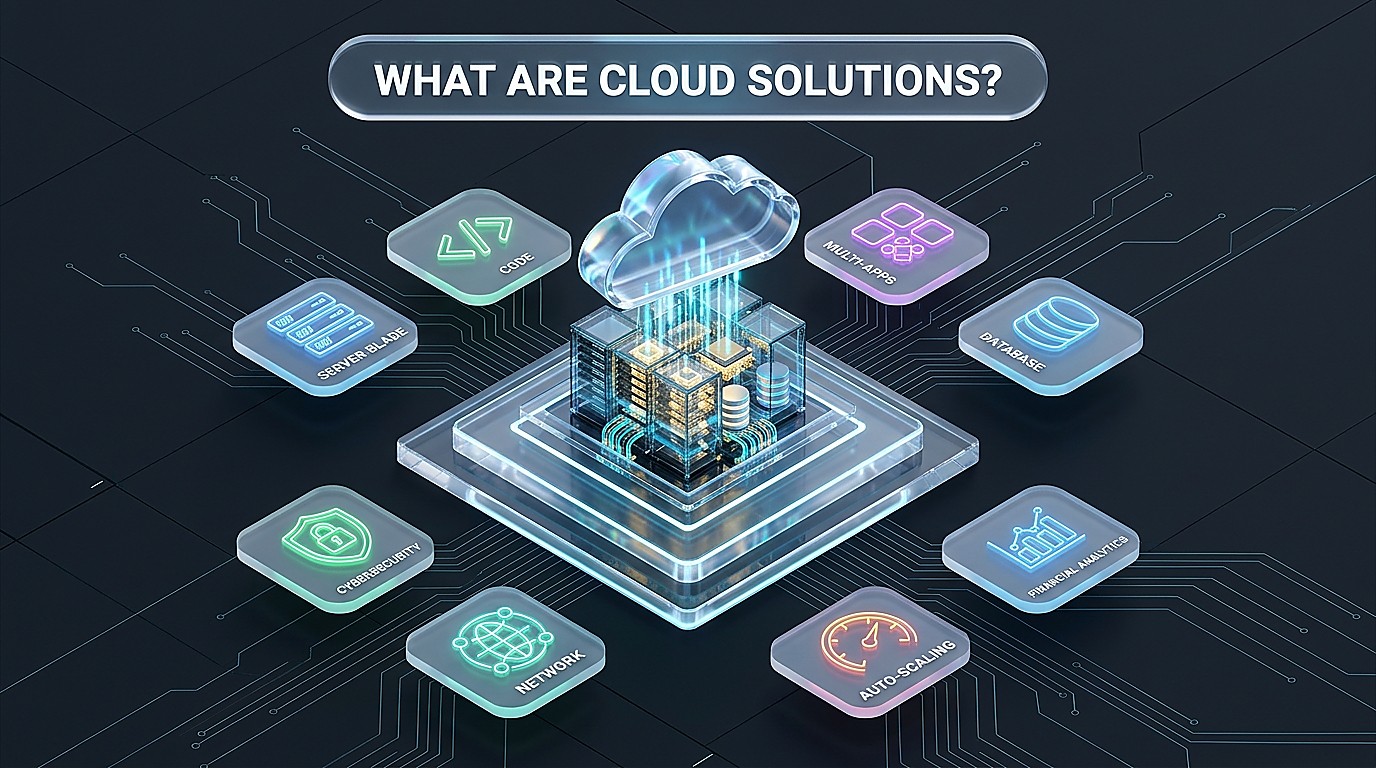
Modern enterprises no longer rely solely on physical server closets, local data centers, or bulky hard-wired computing racks. Over the past decade, internet-delivered infrastructure has fundamentally changed how businesses store data, deploy software applications, and scale operational systems. When executives evaluate modern IT upgrades, the primary question they ask is what are cloud solutions and how can these on-demand architectures support sustainable enterprise growth?
Every commercial organization faces rising infrastructure overhead, remote collaboration demands, and complex cybersecurity requirements. Migrating compute tasks to virtual environments provides immediate cost advantages, elastic scalability, and continuous uptime without massive upfront capital investment. Gaining a crystal-clear understanding of cloud solutions meaning helps decision-makers select the appropriate service tiers for their organizational goals.
This comprehensive operational guide serves as an authoritative cloud solutions introduction and technical playbook. Whether you are seeking a reliable cloud solutions 101 walkthrough or building a detailed multi-year cloud solutions overview for executive leadership, this analysis covers architecture layers, service tiers, deployment models, migration frameworks, and real-world implementation strategies.
Key Strategic Takeaways
- Cloud solutions deliver compute power, databases, software platforms, and enterprise storage on-demand over the internet with pay-as-you-go pricing models.
- Organizations categorize services across three core architectures: Infrastructure as a Service (IaaS), Platform as a Service (PaaS), and Software as a Service (SaaS).
- Modern architectures utilize public, private, hybrid, and multi-cloud deployment topologies to balance operational agility against strict regulatory compliance.
- Implementing cloud solutions technology eliminates hardware lifecycle costs, enables automated disaster recovery, and supports elastic workload scaling during traffic spikes.
- Successful cloud migration demands structured readiness assessments, rigorous identity management, and dedicated FinOps practices to prevent unexpected infrastructure billings.
Understanding the Basics: Cloud Solutions Meaning and Core Definition
Navigating enterprise technology requires establishing a clear baseline terminology. At its fundamental level, the cloud solutions definition refers to any hardware, software, networking, database, analytics, or storage capability delivered to end users and enterprises on-demand via the internet. Rather than purchasing physical equipment, managing local ventilation, and maintaining onsite backup power supplies, companies lease access to massive global data centers operated by specialized hyper-scale infrastructure providers.
A standard cloud solutions basics curriculum begins with how computing resources are virtualized. Physical servers located in geographically distributed data centers are partitioned into thousands of isolated virtual machines using software layers known as hypervisors. This technical virtualization decouples computing workloads from proprietary hardware. End users connect securely over encrypted public networks or dedicated private fiber connections, accessing computing power as easily as turning on an electrical utility.
Evaluating what is cloud solutions in day-to-day enterprise operations reveals three distinct mechanical components: shared pools of compute processors, software-defined storage arrays, and automated resource orchestration layers. When user demand surges during seasonal peaks or promotional campaigns, management software automatically provisions supplementary CPU cores and RAM in seconds. Once demand subsides, those resources spin down instantly, ensuring businesses only pay for the exact compute cycles consumed.
Technical architects evaluate cloud solutions in cloud computing across two primary operating paradigms: centralized computing pools and distributed edge delivery networks. Centralized pools handle intensive analytical calculations, database clustering, and long-term transactional records. Meanwhile, edge nodes position caching servers and serverless microservices geographically closer to end users, dramatically reducing network latency and improving mobile response speeds.
Resource elasticity represents the primary economic driver behind distributed deployments. When traditional data centers hit capacity limits, adding more computing power requires purchasing additional server chassis, running diagnostic burn-in tests, and scheduling maintenance downtime. Cloud environments remove these bottlenecks by abstracting physical limitations behind programmatic provisioning interfaces.
Cloud Solutions Explained: Core Architecture and Enabling Technology
Demystifying how these distributed systems function requires reviewing cloud solutions explained through their architectural layers. At the foundation lies the physical layer, comprising hyperscale data centers equipped with redundant electrical power feeds, liquid cooling systems, diesel backup generators, and enterprise-grade optical fiber backbones. These physical facilities are built to withstand natural disasters, localized power grid failures, and severe environmental stresses.
Above the physical infrastructure operates the virtualization and software-defined abstraction layer. Modern cloud solutions technology leverages container runtimes, software-defined networking (SDN), and software-defined storage (SDS) to pool thousands of separate physical machines into unified virtual compute clusters. APIs (Application Programming Interfaces) provide developers and system administrators with programmatic control over every component, enabling automated infrastructure provisioning via declarative code scripts.
Shifting corporate computing from traditional on-premise hardware to cloud based solutions transforms organizational financial structures. Traditional IT models rely on capital expenditure (CapEx), requiring large upfront outlays every three to five years for server refreshes, router replacements, storage shelf additions, and physical data center real estate leases. In contrast, cloud operating structures function as operational expenditure (OpEx), converting rigid capital depreciation cycles into predictable, metered monthly service expenses.
Modern orchestration layers utilize declarative infrastructure-as-code (IaC) tools such as Terraform and OpenTofu to manage compute assets. Rather than submitting manual configuration tickets to IT administrators, software engineers define network topologies, security groups, database read-replicas, and load balancers inside version-controlled code repositories. When code changes are merged, automated deployment pipelines construct or tear down entire testing environments automatically.
The Five Essential Characteristics of Cloud Architecture
- On-Demand Self-Service: Consumers provision computing capabilities such as server time and network storage automatically without requiring human interaction with each service provider.
- Broad Network Access: Capabilities are accessible across standard network protocols through diverse client platforms including workstations, laptops, tablets, and smartphones.
- Resource Pooling: Provider compute resources are pooled to serve multiple consumers using a multi-tenant model, dynamically assigning physical and virtual resources according to customer demand.
- Rapid Elasticity: Capabilities can be elastically provisioned and released to scale rapidly outward and inward commensurate with fluctuating business workloads.
- Measured Service: Resource usage is monitored, controlled, and reported transparently for both the service provider and enterprise consumer, providing granular billing metrics.
The Three Primary Service Models: Types of Cloud Solutions
Selecting the appropriate technical stack requires categorizing services into standardized tiers. Industry frameworks establish three distinct types of cloud solutions based on the division of responsibility between the enterprise client and the infrastructure provider. These tiers encompass Infrastructure as a Service (IaaS), Platform as a Service (PaaS), and Software as a Service (SaaS).
1. Infrastructure as a Service (IaaS)
Infrastructure as a Service delivers raw computing resources across the internet. Providers supply virtualized server instances, raw block or object storage, network firewalls, and IP routing tables. The enterprise customer retains full administrative ownership and responsibility over the operating system, middleware, software runtimes, database engines, data backups, and application security patches.
Organizations choose IaaS when they require granular control over operating system kernels, legacy application migrations, and specialized networking configurations. Examples include deploying virtual machines on Amazon EC2, provisioning Google Compute Engine instances, or mounting persistent Azure Managed Disks for high-throughput enterprise databases.
2. Platform as a Service (PaaS)
Platform as a Service provides developers with a pre-configured execution environment where applications can be written, tested, debugged, and deployed without managing underlying operating systems or physical server maintenance. The service provider handles OS patching, hardware provisioning, network load balancing, and runtime container orchestration, allowing engineers to focus entirely on writing application source code.
Engineering teams leverage PaaS to accelerate development cycles, automate microservice scaling, and streamline continuous integration pipelines. Common platforms include AWS Elastic Beanstalk, Google App Engine, Microsoft Azure App Services, and Heroku. Serverless computing frameworks such as AWS Lambda and Google Cloud Functions represent specialized event-driven extensions of the PaaS paradigm.
3. Software as a Service (SaaS)
Software as a Service represents the most widely consumed tier of business technology. Under this delivery model, complete end-user applications are hosted, secured, updated, and managed centrally by a software vendor. Enterprise users access the software through web browsers, desktop wrappers, or mobile applications, eliminating local software installations, manual version upgrades, and patch maintenance.
Corporate operations utilize SaaS for unified communications, enterprise resource management, and customer relations. Universal examples include Google Workspace, Microsoft 365, Salesforce CRM, Slack, Zoom, and HubSpot. The customer manages user access permissions and company data, while the vendor guarantees uptime, data protection, and underlying infrastructure performance.
| Service Model | Customer Manages | Vendor Manages | Best For |
|---|---|---|---|
| IaaS (Infrastructure) | Operating Systems, Applications, Runtimes, Middleware, Data | Virtualization, Physical Servers, Storage Arrays, Data Center Facilities | Legacy migrations, custom network setups, deep infrastructure control |
| PaaS (Platform) | Application Source Code, Data Schemas, Integrations | Operating Systems, Runtimes, Virtualization, Server Hardware, Storage | Rapid software development, API backends, modern web applications |
| SaaS (Software) | User Access, Identity Permissions, Organizational Business Data | Entire Stack: Applications, Data Storage, Servers, Security Patches | Standard business functions, email, CRM, team collaboration |
Cloud Deployment Topologies: Public, Private, Hybrid, and Multi-Cloud
Beyond service delivery tiers, organizations must choose how their infrastructure is hosted and partitioned. Deployment topologies determine who owns the physical equipment, where workloads reside, and how isolation boundaries are enforced between different organizations.
Public Cloud
Public clouds provide computing services to the general public or corporate subscribers over open network channels. Multiple independent organizations share the same underlying physical server hardware through strict software virtualization barriers, an operational model known as multi-tenancy. Major public cloud operators maintain massive economies of scale, providing near-infinite resource elasticity, global geographical coverage, and aggressive price competition.
Private Cloud
Private clouds dedicate an entire computing infrastructure exclusively to a single business organization. This architecture can be hosted within an enterprise's on-premise data center or managed by a specialized hosting partner in a dedicated co-location facility. Heavily regulated industries including healthcare, defense, and banking deploy private clouds to maintain strict physical custody over sensitive patient data, intellectual property, and proprietary transactional records.
Hybrid Cloud
Hybrid cloud topologies connect private on-premise infrastructure directly with public cloud providers using encrypted VPN tunnels or dedicated optical cross-connects. This unified topology enables seamless data portability and workload orchestration. Companies retain sensitive database records inside private environments while bursting consumer-facing web traffic into public cloud instances during high-volume sales periods, an architectural strategy known as cloud bursting.
Multi-Cloud Strategy
Modern enterprise IT departments increasingly adopt multi-cloud strategies, intentionally distributing workloads across two or more independent public cloud vendors. Multi-cloud deployments eliminate single-vendor dependency, protect against regional network outages, and allow companies to select best-of-breed specialized tools, such as running machine learning models on Google Cloud while hosting enterprise Active Directory directories on Microsoft Azure.
Operating a successful multi-cloud topology requires robust containerization and platform-agnostic management tooling. When software components are packaged into lightweight Docker containers managed by Kubernetes, applications run identically across on-premise bare-metal nodes, Amazon Web Services instances, or Google Cloud clusters. This abstraction shields developers from vendor-specific proprietary APIs, ensuring long-term technical sovereignty.
| Deployment Model | Security & Governance | Scalability Factor | Cost Characteristics |
|---|---|---|---|
| Public Cloud | Shared multi-tenant infrastructure; robust software-level isolation | Near-infinite, instant automated scaling worldwide | Zero capital investment; pure pay-per-use operating model |
| Private Cloud | Maximum physical and digital security; dedicated single tenant | Restricted by physical hardware capacity limits | High initial capital expenditure; ongoing maintenance staffing |
| Hybrid Cloud | Segmented data classification across private and public domains | High elasticity for public components with stable private core | Balanced hybrid model; requires advanced integration tooling |
| Multi-Cloud | Distributed risk across independent geographic provider networks | Dynamic scaling leveraging multiple global networks | Optimized feature pricing; requires centralized cloud cost management |
Practical Use Cases: Real-World Cloud Solutions Examples
Examining real-world cloud solutions examples illustrates how organizations transform their operational agility through distributed services. From early-stage technology startups to multinational logistics corporations, modern workflows rely on distributed cloud infrastructure to solve daily computational challenges.
Examining practical cloud based solutions examples reveals five core enterprise implementation scenarios:
Automated Data Backup and Disaster Recovery
Maintaining secondary physical data centers for emergency disaster recovery was historically cost-prohibitive for small and mid-sized enterprises. Modern cloud storage solutions provide automated, georedundant replication. Databases and virtual machine snapshots synchronize across distant continental zones continuously. If a physical catastrophe knocks out an enterprise's primary facility, cloud orchestration scripts automatically bring up recovery systems in alternative availability zones within minutes, reducing Recovery Point Objectives (RPO) and Recovery Time Objectives (RTO) to near-zero benchmarks.
Big Data Analytics, AI, and Machine Learning
Processing terabytes of customer behavioral telemetry or training natural language processing models requires massive computational parallelism. Provisioning high-performance GPU clusters on-premise requires hundreds of thousands of dollars in specialized hardware that depreciates rapidly. Modern data engineering teams spin up managed Hadoop or Spark clusters, execute distributed analytical queries over billions of records, train neural networks, and terminate the clusters upon task completion, paying only for the specific hours utilized.
DevOps Continuous Integration and Microservices
Software development lifecycles require rapid testing, staging, and deployment. Container orchestration platforms like Kubernetes running in managed cloud environments allow software teams to automate Continuous Integration and Continuous Deployment (CI/CD) pipelines. Developers commit code revisions to source repositories, triggering automated unit testing, container compilation, and blue-green zero-downtime production rollouts in automated cloud staging environments.
Decentralized Remote Workforce Collaboration
Modern enterprises operate distributed global workforces across dozens of geographic time zones. Cloud-based productivity suites, virtual desktop interfaces (VDI), and identity-aware proxy networks allow team members to securely access internal enterprise applications from any device. Centralized identity management ensures confidential files remain protected within enterprise boundaries, preventing localized data leakage onto unmanaged remote laptops.
E-Commerce Elastic Scale During Seasonal Peaks
Online retail platforms experience extreme traffic variance during holiday promotional periods such as Black Friday or Cyber Monday. On-premise servers frequently crash under sudden order spikes, causing catastrophic revenue loss. In contrast, cloud auto-scaling policies monitor incoming web request queues, automatically spinning up hundreds of supplementary container instances to process shopping carts smoothly, before gracefully downscaling once traffic normalizes.
Industry-Leading Cloud Providers: Detailed Platform Reviews
Organizations evaluating enterprise infrastructure review global market leaders to identify which ecosystem aligns with their specific tech stacks, security frameworks, and technical personnel competencies. Below are the five premier hyper-scale cloud platforms dominating global enterprise deployments.
1. Amazon Web Services
Amazon Web Services represents the pioneer and undisputed market share leader in global cloud infrastructure. Launching its earliest services in 2006, the platform provides over 200 fully featured services covering compute, storage, relational and NoSQL databases, serverless runtimes, machine learning, and Internet of Things (IoT) management. The platform operates across dozens of global geographic regions with deep multi-availability zone redundancy.
Enterprises select this platform for its unmatched service depth, expansive third-party partner ecosystem, and mature governance tooling. Core offerings include Amazon EC2 for virtual compute, Amazon S3 for durable object storage, Amazon RDS for managed database clustering, and AWS Lambda for event-driven serverless architectures. While offering the broadest technical flexibility, navigating its vast pricing tiers requires experienced cloud financial management.
2. Microsoft Azure
Microsoft Azure serves as the preferred enterprise cloud platform for organizations with heavy investments in Microsoft software, including Windows Server, Active Directory, SQL Server, and Microsoft 365. The platform maintains a vast global geographic footprint with more regional data center locations than any competitor, ensuring seamless compliance with localized data sovereignty regulations across international borders.
The platform stands out for its exceptional hybrid cloud integration through Azure Arc and Azure Stack, allowing companies to manage on-premise, edge, and cloud resources through a single administrative pane. Deep integration with enterprise identity directories and developer tools like GitHub and Visual Studio makes it an effortless choice for enterprise software engineering departments.
3. Google Cloud Platform
Google Cloud Platform has earned a dominant reputation for state-of-the-art data analytics, artificial intelligence, machine learning, and native container orchestration. Built on the identical ultra-high-speed fiber network infrastructure that powers Google Search and YouTube, the platform delivers industry-leading network throughput, low latency, and advanced multi-cloud management capabilities.
Organizations choose this provider when building modern data lakehouses, executing complex machine learning pipelines, or orchestrating microservices. Signature tools include BigQuery, a serverless multi-cloud data warehouse that analyzes petabytes of data with zero infrastructure management, Google Kubernetes Engine (GKE), the premier managed container platform, and Vertex AI for training generative models.
4. IBM Cloud
IBM Cloud focuses deliberately on hybrid enterprise deployments, mission-critical legacy mainframe integrations, and heavily regulated industry sectors such as financial banking and healthcare. Leveraging its acquisition of Red Hat, the platform centers its architecture around Red Hat OpenShift, providing seamless application portability across private bare-metal servers and diverse public clouds.
Enterprises prioritize this platform when regulatory compliance, hardware-level cryptographic key management, and financial-grade security controls take precedence over consumer web scale. Its dedicated financial services cloud framework incorporates pre-configured regulatory compliance controls that drastically reduce auditing overhead for enterprise banking institutions.
5. Oracle Cloud Infrastructure
Oracle Cloud Infrastructure was re-engineered from the ground up as a modern generation-two cloud designed specifically to handle high-performance enterprise workloads, massive transactional database clusters, and demanding AI supercomputing clusters. The platform utilizes non-oversubscribed flat networks and bare-metal server options that deliver predictable high-throughput performance.
Organizations running mission-critical Oracle Databases, enterprise ERP systems, and supply-chain applications achieve dramatic cost savings and performance gains on this platform compared to alternative multi-tenant clouds. The platform also offers exceptionally aggressive outbound network bandwidth pricing, making it popular for high-volume data egress workloads.
| Cloud Provider | Core Differentiator | Flagship Services | Ideal Enterprise Fit |
|---|---|---|---|
| AWS | Broadest tool portfolio, largest ecosystem, maximum technical maturity | EC2, S3, RDS, Lambda, DynamoDB | General enterprise, tech startups, complex global microservices |
| Microsoft Azure | Native Microsoft ecosystem synergy, industry-leading hybrid tools | Azure VMs, Blob Storage, Azure SQL, Azure Arc | Corporate enterprise, Windows environments, hybrid cloud setups |
| Google Cloud | Superior data analytics, native Kubernetes leadership, advanced AI | BigQuery, GKE, Compute Engine, Vertex AI | Data engineering, AI/ML research, containerized microservices |
| IBM Cloud | Specialized regulatory compliance, OpenShift container portability | Red Hat OpenShift on IBM, Watson AI, Cloud Bare Metal | Regulated banking, healthcare compliance, legacy mainframe modernization |
| Oracle Cloud | Exceptional database performance, aggressive egress pricing, bare metal | Autonomous Database, Bare Metal Compute, OCI Storage | High-volume transactional databases, Oracle ERP migrations, AI compute |
The Cloud Migration Roadmap: Frameworks and the 6 Rs
Transitioning existing enterprise workloads from on-premise hardware to the cloud requires meticulous strategic planning. Moving applications without an architectural evaluation often leads to performance bottlenecks, governance gaps, and cost overruns. Established industry frameworks rely on the "6 Rs of Cloud Migration" to evaluate each corporate workload.
The 6 Rs Migration Strategy Framework
- Rehost (Lift and Shift): Migrating applications directly from physical servers or local virtual machines to cloud virtual machine instances without modifying core application code. Fast and low-risk, but does not leverage cloud-native elasticity.
- Replatform (Lift, Tinker, and Shift): Making minimal optimizations to take advantage of cloud efficiencies without changing core architecture, such as migrating a self-managed database to a fully managed relational database service.
- Repurchase (Drop and Shop): Retiring legacy on-premise software packages and replacing them with turnkey SaaS solutions, such as swapping on-premise Microsoft Exchange servers for Microsoft 365 or Google Workspace.
- Refactor / Re-architect: Completely re-architecting applications to native microservice, container, and serverless topologies. This approach maximizes scalability and long-term cost efficiency but requires substantial upfront development investment.
- Retire: Identifying redundant, outdated, or underutilized legacy applications across the enterprise estate and decommissioning them completely, reducing license fees and attack surface area.
- Retain: Intentionally keeping specialized workloads on-premise due to strict data sovereignty laws, latency sensitivity, or recent heavy capital investments that have not yet fully depreciated.
Executing an enterprise migration demands phased execution. IT teams begin with detailed discovery and dependency mapping, cataloging every database connection, network port, and external API integration. Pilot workloads with low business criticality are migrated first to validate network bandwidth, identity access controls, and automated backup schedules. Once confidence is established, critical production databases and customer-facing application services transition using parallel cutover strategies that maintain active rollback paths in the event of unforeseen latency spikes.
Cloud Governance, Security, and FinOps Best Practices
Adopting distributed cloud infrastructure introduces new operational disciplines that organizations must master to protect corporate assets and maintain financial discipline.
The Shared Responsibility Security Model
Cloud security relies on a collaborative shared responsibility framework. The cloud provider assumes responsibility for the security OF the cloud, including physical data center perimeter security, hardware maintenance, hypervisor patching, and underlying power infrastructure. Conversely, the enterprise customer retains strict responsibility for security IN the cloud, including identity and access management (IAM), data encryption at rest and in transit, firewall rules, operating system patch management on IaaS virtual machines, and user credential hygiene.
FinOps: Cloud Financial Management
Because cloud resources can be spun up with a simple API call, unmonitored environments frequently experience cloud sprawl, where forgotten test servers, unattached storage volumes, and over-provisioned instances inflate monthly billing statements. Modern companies implement FinOps (Financial Operations) practices to establish financial accountability. Key tactics include setting automated billing alerts, purchasing Reserved Instances (RIs) or Savings Plans for predictable base workloads, and automating schedule-based shutdown of development environments during off-hours.
Total Cost of Ownership: 5-Year Economic Comparison
Evaluating the true Total Cost of Ownership (TCO) between traditional on-premise infrastructure and cloud solutions requires accounting for indirect operational expenses. On-premise accounting must incorporate physical real estate costs, cooling utilities, dedicated power backup generators, annual hardware maintenance contracts, hypervisor licensing fees, and full-time systems engineering salaries. Cloud operating models eliminate physical data center management completely, redirecting engineering hours toward revenue-generating software development and customer feature delivery.
Zero Trust Architecture and Identity Governance
Modern security perimeters no longer stop at the office firewall. A Zero Trust architecture operates on the principle of continuous verification: "never trust, always verify." Every user, device, and API request must authenticate, authorize, and encrypt its communications regardless of whether the traffic originates inside or outside corporate network boundaries. Implementing multi-factor authentication (MFA), least-privilege role-based access control (RBAC), and automated threat detection forms the cornerstone of enterprise cloud protection.
Frequently Asked Questions (FAQs)
What is the primary difference between cloud computing and cloud solutions?
Cloud computing refers to the broad delivery of on-demand computing services over the internet, including raw server processing and storage. Cloud solutions represent the tailored application of those technologies—such as specialized SaaS tools, hybrid network architectures, and automated disaster recovery workflows—designed to solve specific business and operational challenges.
Are cloud solutions secure for sensitive business and financial data?
Yes, major cloud providers maintain sophisticated physical and digital cybersecurity protocols that far surpass the protective capabilities of typical on-premise company server rooms. Providers adhere to international standards such as SOC 2, ISO 27001, HIPAA, and PCI-DSS, utilizing automated threat monitoring, hardware encryption, and strict identity governance.
How does cloud migration help small and medium-sized businesses?
Migrating to cloud environments allows small and medium-sized businesses to access enterprise-grade computing power, global storage networks, and advanced collaboration software without purchasing expensive physical hardware. It eliminates onsite maintenance overhead, protects against data loss, and enables teams to work productively from anywhere in the world.
What is the most common reason enterprise cloud budgets exceed expectations?
Unplanned cloud expenses typically stem from over-provisioning virtual machine sizes, unmonitored network egress traffic, and orphaned storage volumes left running after testing cycles conclude. Establishing dedicated FinOps governance, enforcing automated tagging policies, and purchasing reserved compute commitments prevents these budgetary surprises.