
 +1 571-478-2431
 info@blacktechcorp.com
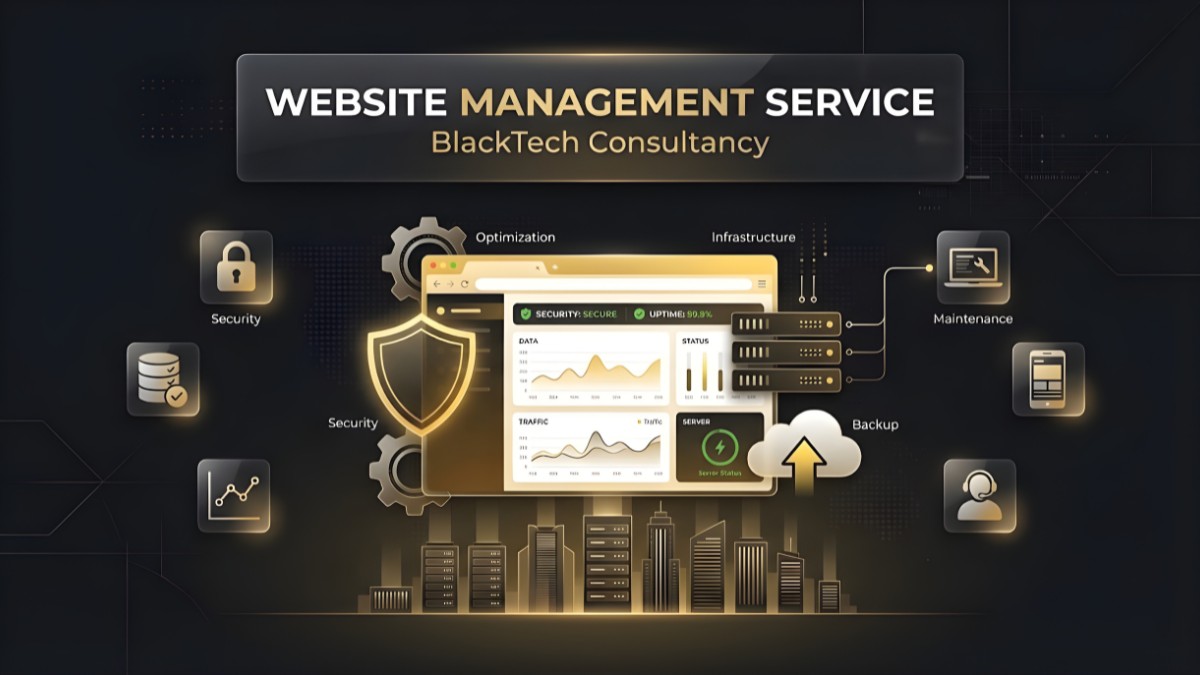
Most business websites work perfectly well on launch day. A year or two later, plugins have gone unupdated, a contact form quietly stopped sending emails months ago without anyone noticing, and the site is one unpatched vulnerability away from a bad afternoon. Nobody decided to let this happen — it simply wasn't anyone's job to check. That gap between "the site launched successfully" and "someone is actually watching it" is exactly what Professional Website Management in South Africa exists to close, and it's a far more common problem than most business owners realize until something finally breaks in a way that's impossible to ignore.
Professional Website Management is often thought of as a backup plan for when something goes wrong, but the more valuable part of the work happens well before anything breaks. Software updates that patch security holes, backups that actually get tested rather than just scheduled, uptime monitoring that catches a problem within minutes instead of when a customer complains, and performance checks that keep pages loading quickly as content and plugins accumulate — all of it is preventive by design. A website left alone doesn't stay the way it launched; it slowly drifts toward becoming a liability, the same way a car that never gets an oil change doesn't fail on day one, but eventually fails at the worst possible moment.
Businesses come to BlackTech Consultancy for Professional Website Management in South Africa for a fairly predictable set of reasons. Some had a site built by an agency or freelancer who disappeared once the invoice was paid, leaving nobody responsible for what happens next. Others have an internal team member who used to handle updates informally, until that person left or simply got too busy to keep it up. A number arrive after a real incident — a hacked site, a security warning in the browser, a plugin conflict that took the whole site down during a busy sales period — and want a system in place so it doesn't happen again.
The businesses that avoid these problems tend to share one trait: they treat a website as infrastructure that needs regular attention, not as a project that finished the day it launched. A site in South Africa that's actively monitored, patched, and backed up holds up under real-world conditions — traffic spikes, plugin updates, browser changes — in a way a site left untouched simply doesn't, no matter how well it was originally built.
Work Behind Professional Website Management
Professional Website Management covers a set of recurring tasks that individually seem small but compound into serious problems when skipped for long enough. Core software, themes, and plugins need regular updates — not just for new features, but because a large share of updates exist specifically to patch security vulnerabilities that get publicly disclosed the moment a fix is released, which makes an outdated site a known, documented target rather than an obscure one. Left unpatched for months, a site accumulates multiple unresolved vulnerabilities at once, each one a separate way in for anyone scanning for exactly that weakness.
Backups are the piece most businesses assume are happening automatically and are wrong about more often than expected. A backup that's never been tested is a backup nobody actually knows will work when it's needed — restoring a corrupted or hacked site depends entirely on having a clean, complete, recent copy to go back to, and finding out a backup is broken during an actual emergency is one of the worst possible times to discover it.
Uptime and performance monitoring catch a different category of problem: the kind that doesn't announce itself. A site can go down for hours before a business owner happens to check it, and a slow-loading page can quietly lose visitors and search ranking for weeks before anyone connects the dots. Monitoring exists to catch both immediately, often before a single customer notices anything is wrong.
Security goes beyond patching software. Firewall rules, login protection against repeated password attempts, malware scanning, and SSL certificate renewal all need ongoing attention, since a lapsed certificate or an unnoticed malware injection can silently damage both search rankings and customer trust well before anyone realizes there's a problem to fix.
South Africa Growing Website Maintenance Gap
The number of businesses in South Africa running a website has grown steadily, but the number of businesses with someone actually responsible for maintaining that website hasn't kept pace. Many sites were built once, by an agency, freelancer, or internal hire, with no ongoing arrangement put in place afterward — which means updates simply stop the day the invoice is paid, whether or not anyone decided that on purpose.
The businesses that do stay on top of it tend to have a real advantage, and not always an obvious one. A faster, more secure, more reliably available site outperforms a neglected one in search rankings, in customer trust, and in plain uptime — three things that compound over time in ways a business without dedicated maintenance rarely notices until a competitor's site is simply working better across the board.
There's also a compliance and liability dimension that's easy to underweight. A site handling customer data — payment details, account information, even just a contact form — carries real exposure if that data gets compromised through an unpatched vulnerability. Regulatory expectations around data protection have only gotten stricter, and "we didn't know the plugin was outdated" is rarely treated as an adequate explanation after a breach has already happened.
Businesses running multiple sites, multiple locations, or a mix of a marketing site and an e-commerce store face a coordination challenge that gets harder without a dedicated system in place. Keeping every property patched, monitored, and backed up on a consistent schedule is difficult to sustain internally once there's more than one property to track, particularly for a team whose actual job has nothing to do with web infrastructure.
There's also a real cost to delay, and it isn't hypothetical. A site with unpatched vulnerabilities isn't at risk someday — it's at risk today, for every day it stays unpatched. The cost of professional Professional Website Management is fixed and predictable; the cost of a breach, an extended outage, or a search ranking collapse from a hacked site is neither, and tends to be considerably higher than what ongoing maintenance would have cost across the same period.
Professional Website Management Services at BlackTech Consultancy
BlackTech Consultancy's Professional Website Management team in South Africa works from a defined scope of recurring services rather than an informal, reactive arrangement. Every plan includes updates, security, backups, performance monitoring, and direct support, scaled to the size and complexity of the site being maintained.
Updates & Core Maintenance
Core software, themes, and plugins get updated on a regular, tested schedule rather than left to accumulate. Updates are checked on a staging environment before going live wherever possible, since an update that breaks a live site unexpectedly is a common and entirely avoidable problem when changes go straight to production without a test step first.
Security Monitoring & Hardening
Ongoing security work includes malware scanning, firewall rules, login protection against brute-force attempts, and SSL certificate management. When a threat is detected, response happens immediately rather than at the next scheduled check-in, since a compromised site left live for even a short window can do damage to search rankings and customer trust that takes much longer to undo.
Backups & Disaster Recovery
Automated backups run on a defined schedule, stored separately from the live site so a server-level issue can't take out both the site and its backup at once. Recovery procedures are documented and periodically tested, so a restoration, if it's ever needed, is a known, practiced process rather than something being figured out for the first time during an actual emergency.
Performance & Speed Optimization
Page load speed gets monitored over time, not just checked once at launch, since performance tends to degrade gradually as content, plugins, and third-party scripts accumulate. Image optimization, caching configuration, and database cleanup are handled proactively to keep a site fast as it grows rather than waiting for a visible slowdown to trigger a fix.
Reporting & Ongoing Support
Clients receive regular reports covering what was updated, what was monitored, and any issues addressed during the period, so maintenance work stays visible rather than happening invisibly in the background. Direct support is available for content updates, small changes, and urgent issues, without needing to track down whoever originally built the site.
Our Process
Every engagement starts with a technical audit of the current site — what platform it runs on, how outdated its software is, whether backups already exist, and what security gaps, if any, are already present. This audit gives a concrete starting point rather than a generic recommendation applied without actually looking at the site first.
From there, a written plan lays out the recommended service tier, what gets addressed immediately versus on an ongoing basis, and the monthly investment involved, so a business has a specific document to review rather than a vague promise of "ongoing support." Anything urgent uncovered during the audit — an expired certificate, an already-outdated plugin with a known vulnerability — gets flagged and addressed as a priority rather than folded quietly into the regular schedule.
Once a plan is approved, onboarding includes setting up monitoring, establishing a backup schedule, and applying any immediate security fixes identified during the audit. From that point forward, updates and monitoring run on a consistent schedule in the background, with direct communication whenever something needs a client's attention or approval before changes are made.
Reporting happens on a defined cadence, so a business always knows what's been done and what, if anything, needs a decision on their end. For anything urgent — a site going down, a security alert, a broken checkout flow — response happens outside the regular schedule, on the timeline the issue actually demands rather than waiting for the next scheduled check-in.
Communication runs directly with the people doing the actual maintenance work, not through a rotating support queue that starts from zero context every time a new ticket gets filed. Whoever answers a client's message already knows the site's history, which shortens the time between reporting an issue and actually resolving it.
BlackTech Consultancy Versus the Alternatives
Businesses weighing Professional Website Management in South Africa are usually comparing three real options: doing nothing and hoping the site keeps working, hiring a freelancer for occasional fixes, or setting up an ongoing arrangement with a firm like BlackTech Consultancy.
Doing nothing is, statistically, the most common choice, mostly by default rather than by decision — and it's also the option that carries the most risk, since an unmaintained site accumulates vulnerabilities and technical debt silently until something finally forces the issue. The eventual cost of an emergency fix, a breach cleanup, or a full rebuild after years of neglect is almost always higher than what consistent maintenance would have cost across the same stretch of time.
A freelancer hired for occasional fixes can be a reasonable, affordable option for a business with very simple needs, but this arrangement is inherently reactive — issues get addressed after they've already caused a problem, not caught and prevented beforehand. Availability is also a real constraint: a freelancer juggling other clients may not respond quickly during an actual emergency, and pricing for one-off fixes can add up to more over a year than a predictable monthly plan would have cost.
BlackTech Consultancy's ongoing plans are built around predictable pricing and consistent, proactive attention rather than reactive fixes billed one at a time. A fixed monthly cost covers updates, monitoring, security, and backups as standard, which makes budgeting straightforward and avoids the surprise invoices that come with paying for emergency fixes after the fact. Direct support means questions and issues get handled by people who already know the site's setup and history, not a support queue starting from scratch each time, and response on urgent issues happens on a timeline that matches the actual severity rather than a generic ticket rotation.
Industries We Serve
The businesses that benefit most from Professional Website Management in South Africa tend to have a site that matters to daily operations — generating leads, processing orders, or serving as a primary point of contact — and simply hasn't had consistent attention since it launched. A few categories come up often, though the underlying need extends well beyond this list.
Nonprofits & Associations
A nonprofit relying on its website for donations and event registration often runs on a lean team with no dedicated technical staff, which means maintenance tends to fall to whoever has time rather than whoever should be responsible for it. A donation form that silently breaks, or a site that goes down during a major fundraising push, has a direct and immediate financial impact that a for-profit business with more revenue cushion might absorb more easily.
Professional Services
A law firm, accounting practice, or consulting group depends on its site to project credibility to prospective clients doing due diligence before reaching out. An outdated, slow, or visibly neglected site undermines exactly the trust a professional services firm depends on to convert a visitor into an inquiry, regardless of how strong the actual practice behind it is.
E-Commerce & Retail
A WooCommerce or Shopify store handling live transactions carries more urgency than a static marketing site — downtime translates directly into lost sales, and a security issue involving customer payment information carries real legal and reputational exposure. Consistent monitoring and rapid response to issues matter more here than in almost any other category, since every hour of downtime has a directly measurable cost.
Franchises & Multi-Location Businesses
A franchise or multi-location business often manages several similar sites at once, and keeping all of them patched, backed up, and monitored on a consistent schedule is difficult without a dedicated system. Inconsistent maintenance across locations tends to produce exactly the kind of visible gap — one location's site looking noticeably worse or running slower than another's — that undermines the sense of a unified, reliable brand.
Content & Media Publishers
A publisher or blog with a large volume of content and heavy traffic tends to accumulate plugins, scripts, and database bloat faster than most other site types, which makes performance monitoring and regular cleanup especially important. A slow-loading site directly affects both reader experience and search visibility, both of which are core to how a content business generates revenue in the first place.
In each of these cases, the site itself usually isn't the problem — the absence of anyone consistently responsible for it is. The role of Professional Website Management in that situation is to close that gap permanently, rather than patching it once and leaving the same underlying risk to build back up over time.
Packages & Pricing
Professional Website Management is priced as a predictable monthly plan rather than a one-time project fee, since the value of the work comes from consistency over time rather than a single completed task. The three tiers below outline typical scope, though every plan is ultimately shaped around the specific platform, traffic, and risk profile of the site being maintained.
| Plan | What's Included | Response Time | Best For | Monthly Investment |
|---|---|---|---|---|
| Essential | Core updates, malware scanning, automated backups, basic uptime monitoring | Within 1 business day | Small business or brochure sites with modest traffic | Custom Quote |
| Business | Everything in Essential, plus performance optimization, firewall management, monthly reporting, minor content updates | Within 8 business hours | Active business or e-commerce sites generating leads or sales | Custom Quote |
| Priority | Everything in Business, plus 24/7 monitoring, priority emergency response, multi-site coordination, dedicated support contact | Within 1 hour, 24/7 | High-traffic, multi-location, or revenue-critical sites | Custom Quote |
Regardless of plan, an initial audit and written scope are always provided before any commitment is required, breaking down exactly what's included and what the monthly cost looks like. Any urgent issue uncovered during onboarding is addressed as a priority, and plans can be adjusted up or down as a site's traffic and needs change over time.
Results You Can Expect
The first thing most businesses notice after starting Professional Website Management is a drop in surprises. Issues that used to surface as a broken form or a hacked page get caught during routine monitoring instead, usually before a customer ever encounters them. That shift, from finding out about problems from customers to finding out from a monitoring alert, tends to matter more to business owners than almost any other single change.
Site speed and reliability improve as a direct result of consistent attention rather than a one-time cleanup that gradually erodes again over months. A site that gets regular database maintenance, image optimization, and plugin auditing tends to stay fast even as content and functionality grow, instead of slowly degrading the way an unmaintained site typically does.
Security posture improves in a way that's hard to see day to day but matters enormously the one time it's tested. Patched software, active monitoring, and a tested backup all reduce both the likelihood of a successful attack and the damage if one happens anyway, turning a potential multi-day outage and cleanup into a fast, contained incident instead.
Budget predictability is a benefit that's easy to overlook until it's compared against the alternative. A fixed monthly cost for maintenance is straightforward to plan around, while emergency fixes, breach cleanup, and unplanned downtime carry costs that are both larger and far less predictable, often arriving at the worst possible moment for a business's cash flow.
Finally, having a dedicated point of contact for the website removes a recurring source of internal friction. Content updates, small changes, and technical questions get handled by someone who already knows the site, instead of falling to whoever on staff happens to have the most technical patience, or getting delayed indefinitely because nobody is quite sure who should handle it.
Getting Started
A short technical audit is usually enough to show exactly where a site stands — what's outdated, what's already at risk, and what a maintenance plan should prioritize first. On a free consultation call, BlackTech Consultancy's Professional Website Management team in South Africa reviews the current state of a site and gives a direct read on urgency, rather than a generic sales pitch regardless of what the audit actually finds.
There's no pressure attached to the call itself. It exists to give a business a clear picture of where its site stands and what fixing or maintaining it would actually involve, not to push a plan before the fit has been established on both sides. Reaching out is straightforward: call +1 571-478-2431 or send a message to info@blacktechcorp.com to get a conversation scheduled.
FAQs
How much does Professional Website Management in South Africa cost?
Cost is a predictable monthly fee based on the plan level, the platform, and the traffic and complexity of the site involved. A simple brochure site costs considerably less to maintain than a high-traffic e-commerce store, and an exact figure follows the initial technical audit.
What's the difference between website management and a one-time web design project?
Web design is a project with a defined start and end that produces the site itself; Professional Website Management is the ongoing work that keeps that site secure, fast, and functional after launch. Most businesses need both — one to build the site, and the other to keep it working well over time.
What happens if the site goes down or gets hacked?
Response happens outside the regular maintenance schedule, on a timeline based on plan level, with Priority-tier clients getting 24/7 response within an hour. A tested, current backup means a compromised or broken site can typically be restored quickly rather than requiring an emergency rebuild from nothing.
Does BlackTech Consultancy work with WordPress, Shopify, and WooCommerce?
Yes — plans are built around the specific platform a site runs on, whether that's WordPress, Shopify, WooCommerce, or a custom-built site, since each platform has different update processes, security considerations, and common failure points.
Can BlackTech Consultancy take over maintenance from a previous developer or agency?
Yes, this is one of the most common ways engagements start. The process begins with a technical audit to understand the current state of the site, flag anything urgent, and establish a maintenance baseline going forward, regardless of who built or previously maintained the site.
Are backups actually tested, or just scheduled?
Backups are both scheduled and periodically tested through an actual restoration process, since an untested backup carries real risk of failing at the exact moment it's needed. Recovery procedures are documented so a restoration, if required, follows a known, practiced process.
Is there a contract, or can a plan be canceled?
Plans run month to month rather than locking a business into a long-term contract, and can be adjusted or canceled as needs change. Details on notice periods and any transition support are covered clearly in the written plan before a business commits.
What's the first step to get started?
The first step is a free consultation call and a technical audit of the current site, which leads to a written plan with a clear scope and monthly cost before any commitment is required.
BlackTech Consultancy
Virginia, United States
+1 571-478-2431
info@blacktechcorp.com
https://www.blacktechcorp.com/