
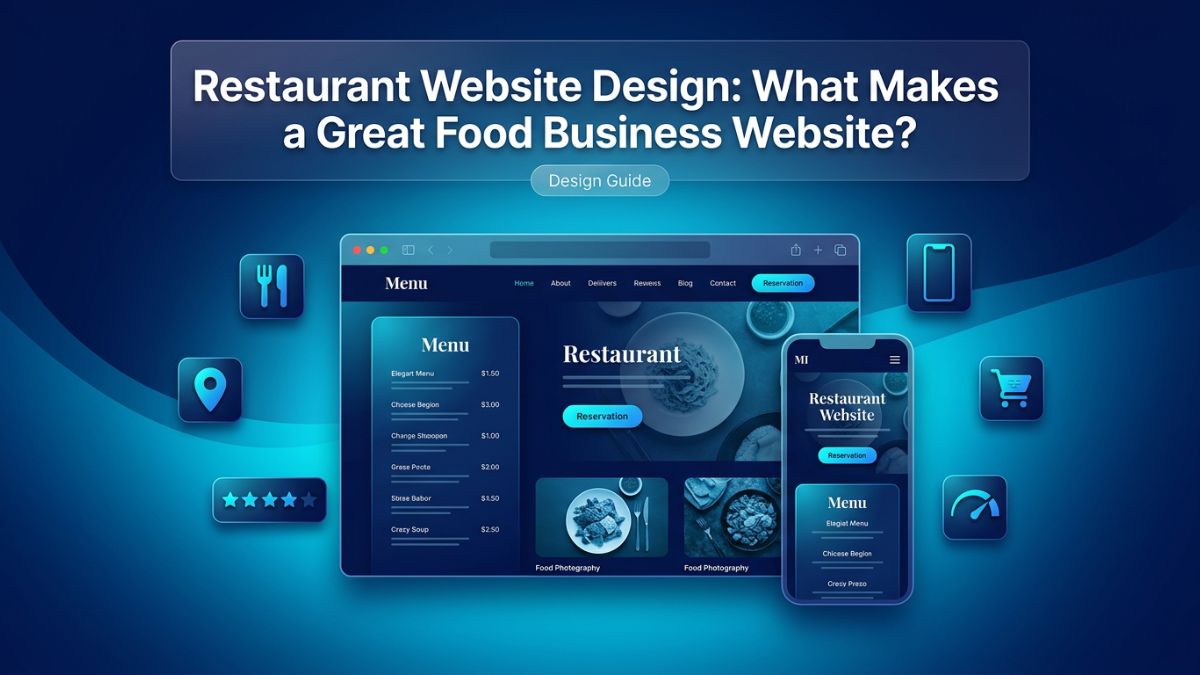
More than 90% of people research a restaurant online before they ever walk through the door. If your website fails that first impression — slow to load, hard to navigate, or missing basic information — they move on to your competitor. Restaurant website design is not just about making something look appealing. It directly determines whether a potential customer books a table, places an order, or leaves without any action. The restaurants winning online right now have websites built with clear intention — fast, functional, and designed around how real customers behave. This guide breaks down exactly what that looks like.
Why Restaurant Website Design Matters
Restaurant website design refers to the planning, visual design, structure, and technical build of a website specifically created for a food service business — whether that's a fine dining establishment, a local café, or a fast-casual chain. It includes layout, navigation, content, performance, and the systems that support online ordering, reservations, and local search visibility.
According to a study by Upserve, 77% of diners visit a restaurant's website before making a dining decision. That number should put the stakes into clear perspective. A weak or outdated website does not just cost you traffic — it directly costs you customers and revenue.
A well-designed food business website functions as a 24/7 sales and customer service tool. It answers questions, builds trust through visuals and reviews, and gives customers every reason to choose you over a competitor. For small and independent restaurants especially, a professional website is often the single most important digital asset a business owns.
The websites performing best in local search results are not accidents. They are built with a deliberate strategy that covers design, speed, content, and technical SEO from day one.
Core Elements of Effective Restaurant Website Design
High-Performing Food Business Website
Getting restaurant website design right means understanding that every element on the page serves a specific purpose. Design without strategy is decoration. The components below are what separate websites that attract and convert customers from ones that simply exist online.
Mobile-Friendly Restaurant Website Design Comes First
The majority of restaurant searches happen on a smartphone — often while someone is already out and looking for a place to eat. A responsive restaurant website design ensures that every page, image, menu, and button works flawlessly across all screen sizes without requiring pinching, zooming, or frustrating scrolls.
Google uses mobile-first indexing, which means the mobile version of your site is what gets evaluated for search rankings. If your restaurant's site looks great on desktop but breaks on mobile, your visibility in local search suffers significantly. Mobile optimization is not optional — it is the baseline standard.
Practical check: load your site on three different phones and test every core function — menu viewing, reservation booking, click-to-call, and map directions. If any of those fail or feel awkward, that is a problem losing you customers right now.
Restaurant Website Speed Optimization and Core Web Vitals
Page speed is a confirmed Google ranking factor and a direct driver of user behavior. Research from Google shows that a one-second delay in mobile page load time can reduce conversions by up to 20%. For restaurants — where impulse decisions are common — a slow site kills intent before it turns into action.
Core Web Vitals measure three key performance signals: Largest Contentful Paint (how fast the main content loads), First Input Delay (how quickly the page responds to interaction), and Cumulative Layout Shift (how stable the page is as it loads). Failing these benchmarks hurts both rankings and user experience.
A fast-loading restaurant website typically uses compressed images, a reliable hosting provider, minimal unnecessary scripts, and a clean codebase. If your site is running on bloated themes or outdated plugins, a technical audit is usually the starting point for improvement.
Restaurant Online Ordering and Reservation System Integration
A restaurant website without a working online ordering or reservation system is leaving money on the table. Customers expect to be able to book a table or place an order directly from your website — not be redirected to a third-party platform that charges your business a percentage of every sale.
Integrating a native restaurant booking website design with a built-in reservation system keeps the customer on your site, reduces commission fees, and gives you ownership of the customer data. Systems like OpenTable, Resy, or custom-built reservation modules can be embedded directly into your website design for a smooth user experience.
For restaurants offering delivery or takeout, a restaurant website for online orders with a built-in cart, payment gateway, and order confirmation flow converts significantly better than forcing customers off-site to complete a purchase.
Restaurant Menu Website Design That Actually Sells
The menu is the most visited page on almost any restaurant website. Yet many restaurants still publish their menu as a PDF that is impossible to read on mobile, cannot be indexed by search engines, and requires a download to view. That approach frustrates users and harms SEO simultaneously.
A strong restaurant menu website design presents menu items as live HTML content — readable on any device, searchable by Google, and easy to update without rebuilding pages. Each item can include a photo, description, price, and dietary information that helps customers make decisions faster.
From a search perspective, your menu content is also an opportunity. Dish names, ingredients, and categories are terms real people search for. Structuring your menu as properly coded web content — rather than a static document — opens up significant organic search opportunities that a PDF will never capture.
Restaurant Branding Website Design and Visual Identity
A restaurant's brand is not just a logo — it is the entire visual and emotional experience a customer has before they arrive. The color palette, typography, photography style, and tone of voice on your website all communicate what kind of experience a customer can expect.
Fine dining website design demands a different visual language than a casual cafe website design or a food delivery website. The visual choices need to match the actual dining experience — otherwise there is a disconnect that creates doubt. Professional food photography is one of the most impactful investments a restaurant can make for its website. Images that look dark, blurry, or stock-generic fail to trigger appetite and desire.
Custom restaurant website design built around your actual brand identity — rather than a generic template — communicates professionalism and attention to detail. That perception matters before a customer ever tastes the food.
Best Practices for Restaurant Website Design
Expert Tips for Building a Restaurant Website That Converts
These are not surface-level suggestions. These are specific, tested practices that produce measurable improvements in search visibility, customer engagement, and online revenue for food businesses.
1. Build for local search from the start, not as an afterthought.
Restaurant website SEO should be embedded into the site's architecture — not added later as a patch. This means using location-specific page titles and meta descriptions, embedding a Google Map, ensuring your NAP (Name, Address, Phone) information is consistent and text-based (not an image), and implementing restaurant schema markup. Schema markup tells Google exactly what your business is, where it is, what it serves, and what your hours are — which directly improves your presence in local search results and Google's Knowledge Panel.
2. Use high-quality food photography on every key page.
Pages with professional food photography consistently outperform those with stock images or low-quality photos in both time-on-page and conversion rate. You do not need a full production shoot — a set of well-lit, phone-quality images of your best dishes, taken in your actual space, will outperform generic imagery. Update food photos seasonally to keep the site content fresh.
3. Place clear calls-to-action above the fold on every page.
Restaurant website conversion optimization depends on removing friction from the customer's decision path. Every key page — homepage, menu, contact — should have a visible, accessible CTA before the user scrolls. "Reserve a Table," "Order Now," and "View Our Menu" should be buttons, not buried text links. A/B testing two different CTA placements or colors using a tool like Google Optimize can produce 15–30% improvements in click-through rates.
4. Add structured customer reviews and social proof throughout the site.
A restaurant social proof website integrates reviews not just as a dedicated page, but throughout the customer journey. Displaying Google or Yelp reviews on the homepage, menu page, and contact page reinforces trust at every decision point. Schema markup for reviews also helps ratings appear directly in Google search results — a visual signal that increases click-through rates from search.
5. Optimize for voice search with natural-language content.
A growing percentage of local restaurant searches happen through voice — "Where can I eat Italian food near me?" or "Is [restaurant name] open right now?" A voice search optimized restaurant website answers these questions directly in its content. This means including FAQ content with natural conversational questions and answers, keeping your hours and location information current, and using full sentences rather than keyword-only fragments in your copy.
Common Restaurant Website Design Mistakes That Cost Real Business
Most of these mistakes are not made from carelessness — they are made because restaurant owners are focused on running their business, not managing a website. But each of these errors has a direct, measurable cost.
Mistake 1: Hiding or PDF-ing the Menu
Publishing a menu as a downloadable PDF is one of the most common and most damaging decisions a restaurant website makes. PDFs do not render properly on mobile, cannot be read by search engines, and require an extra step that many users abandon. The fix is to rebuild the menu as structured HTML content with proper headings, descriptions, and images — something a web developer can complete in a single work session.
Mistake 2: No Clear Address, Hours, or Contact Information on the Homepage
A surprising number of restaurant websites bury their location, hours, and phone number deep in a contact page — or omit them from the homepage entirely. Customers searching for your restaurant want that information immediately. Put your address, current hours, and a click-to-call phone number in the header or above-the-fold section of every page. Missing this information is not just a UX failure — it is a local SEO problem that reduces your relevance in Google's local results.
Mistake 3: Ignoring Restaurant Website Accessibility
Restaurant website accessibility means ensuring your site can be used by people with visual, auditory, or motor impairments — including screen reader compatibility, sufficient color contrast, and keyboard navigability. Beyond the ethical obligation, there is a legal one. Websites that fail to meet accessibility standards (such as WCAG 2.1 or Section 508 requirements) expose businesses to legal risk. The practical fix is an accessibility audit followed by targeted remediation — not a full rebuild, in most cases.
Mistake 4: Using Cheap Templates Without Custom Configuration
Off-the-shelf restaurant WordPress website templates are a starting point — not a finished product. Restaurants that launch a template without customizing page speed, SEO settings, mobile behavior, and brand identity end up with sites that look generic and perform poorly. Template use is fine as a foundation, but custom restaurant website design investment — at minimum in configuration and content — is what produces results. A site that looks like every other template-built restaurant in your area gives customers no reason to feel your brand is distinct.
Frequently Asked Questions About Restaurant Website Design
What is restaurant website design and what does it include?
Restaurant website design is the process of planning, building, and optimizing a website specifically for a food service business. It includes the visual layout, navigation structure, menu presentation, online ordering or reservation systems, local SEO setup, mobile responsiveness, and page speed performance. A complete restaurant website build covers both the user-facing design and the technical foundation that makes the site visible and functional.
How do I make my restaurant website show up on Google?
Ranking on Google starts with implementing local SEO correctly. This means using location-specific keywords in your page titles and headings, adding restaurant schema markup so Google can read your business details, keeping your Name, Address, and Phone number consistent across your website and Google Business Profile, and building content around the terms your local customers actually search. A fast, mobile-friendly site with fresh, relevant content ranks far more consistently than a slow or outdated one.
How much does it cost to design a restaurant website?
Restaurant website design costs vary based on scope and complexity. A basic template-based site configured professionally may range from $1,500 to $3,500. A custom restaurant website design with online ordering, a reservation system, and SEO integration typically ranges from $4,000 to $10,000 or more depending on the features required. Ongoing maintenance, hosting, and SEO services add monthly costs. The return on investment from a well-built site — through online orders, reservations, and reduced reliance on third-party delivery platforms — generally justifies the initial spend within months.
What is the difference between a template and a custom restaurant website?
A template is a pre-built design structure that can be adapted to your brand, while a custom restaurant website is built specifically for your business from the ground up. Templates are faster and less expensive but often limit flexibility in layout, performance optimization, and feature integration. Custom builds offer full control over design, speed, functionality, and brand alignment. For restaurants with specific workflows — like multi-location ordering systems or integrated loyalty programs — custom development is usually the more practical long-term solution.
Does my restaurant website need a reservation system and online ordering?
Yes — for most restaurants, both features are strongly worth integrating. A restaurant booking website design with a native reservation system keeps the booking experience on your site, reduces dependency on third-party platforms, and gives you direct access to customer data for marketing. Online ordering capability directly increases revenue from customers who prefer ordering ahead or having food delivered without using a commission-heavy app. Even small restaurants see meaningful revenue gains from removing the friction of directing customers off-site to complete a transaction.
How often should a restaurant website be updated or redesigned?
Active content — menus, hours, specials, and event announcements — should be updated as often as those details change. A broader design review or restaurant website redesign is typically warranted every 2–3 years to address changes in user expectations, mobile standards, SEO best practices, and visual trends. If your site was built more than four years ago without updates, it is likely underperforming in both search and usability — a technical and design audit is a practical first step before committing to a full rebuild.
A restaurant website is not just a digital business card — it is the foundation of every online interaction your customer has with your brand before they step through your door or place an order. Getting restaurant website design right means building something that is fast, mobile-optimized, locally visible, and structured to remove every barrier between a curious visitor and a confirmed customer. The restaurants that invest in this strategically outperform those that treat it as a secondary concern. If your current website is not doing that work for you, now is the time to change it.
Schedule an Appointment with BlackTech Consultancy
If your restaurant's website is not bringing in the reservations, orders, and local visibility your business deserves, our team can help you fix that with a strategy built around your specific goals.
BlackTech Consultancy
Virginia, United States
+1 571-478-2431
info@blacktechcorp.com
https://www.blacktechcorp.com/