
- Blog
- Nov 18, 2026
Every day, billions of people open a search bar or an AI-powered answer engine looking for solutions, products, local providers, and reliable answers. Whether a homeowner searches for an emergency plumber, a procurement manager compares enterprise software vendors, or a student researches a new technical skill, the websites appearing at the top of those results capture the overwhelming majority of clicks, trust, and revenue. Earning that visibility consistently—without paying for every single click—is the core purpose of search engine optimization.
New website owners and marketing leaders often feel overwhelmed by technical terminology, conflicting advice, and constant algorithm updates. Yet beneath the jargon lies a remarkably logical system built around one goal: helping search platforms understand your pages clearly and proving that your content delivers the most trustworthy answer for a specific user need. When approached systematically, seo for beginners becomes an accessible, repeatable growth discipline rather than a mysterious black box.
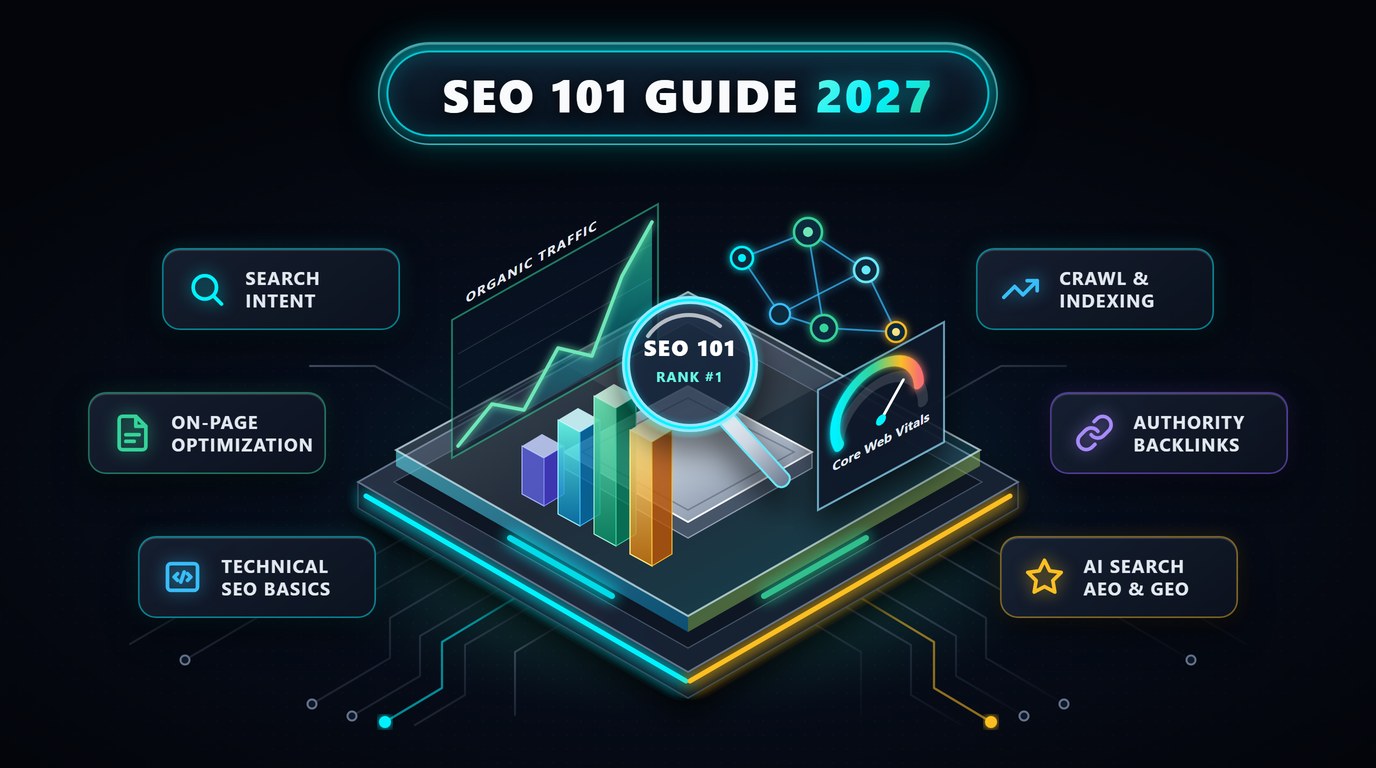
This comprehensive seo guide walks through every essential layer of modern organic search as it operates in 2027. From grasping the exact seo meaning and how automated crawlers evaluate web pages to executing keyword research, technical optimization, authority building, and AI search readiness, every chapter translates complex mechanics into clear, actionable steps that individuals and organizations can apply immediately.
Key Strategic Takeaways
- Search engine optimization improves a website's technical health, content relevance, and external authority so it earns unpaid organic visibility across traditional search engines and AI answer engines.
- Modern search systems evaluate pages across four interconnected pillars: technical accessibility, on-page relevance, off-page authority, and structured entity clarity for AI retrieval.
- Matching genuine user search intent matters far more than repeating exact phrases; pages that answer the reader's underlying problem thoroughly outperform thin, over-optimized articles.
- Unlike paid advertising, which stops delivering leads the moment budgets pause, well-executed organic search builds compounding digital equity that reduces customer acquisition costs over time.
- Beginners achieve the fastest early wins by setting up free first-party analytics, fixing basic crawling roadblocks, and publishing deeply helpful answers around focused, low-competition topics.
What Is SEO? Clear Definition, Acronym, and Business Meaning
Starting from square one requires answering the most frequently asked question in digital marketing: what is seo, and why does nearly every growing company invest in it? At its simplest level, the seo acronym comes from three straightforward words. The seo full form is Search Engine Optimization, meaning seo stands for the structured process of refining a website so search platforms like Google, Bing, and AI-driven answer engines rank its pages prominently for relevant user queries.
When textbooks and industry standards outline a formal seo definition, they describe both an engineering discipline and a communication practice. To seo define accurately for modern web environments, think of it as aligning three separate perspectives simultaneously: what human visitors want to accomplish, what your website publishes, and how automated software systems interpret and verify that information. People who search for seo what is it often expect a list of secret tricks, yet sustainable rankings rarely stem from loopholes. Instead, search platforms reward websites that load quickly, organize information logically, answer real questions accurately, and earn genuine endorsements from other reputable sites.
Understanding SEO in Marketing and Commercial Operations
Separating technical mechanics from commercial outcomes clarifies why executives care deeply about organic search. In commercial planning, the seo definition marketing professionals rely upon centers on capturing high-intent demand at the exact moment a prospective customer actively seeks a solution. Interruptive advertising—such as billboards, television spots, or social media feed ads—tries to grab attention from people who may have no immediate interest in buying. Organic search operates in reverse by placing your brand directly in front of users who are already raising their hands with a specific need.
Looking closely at seo meaning in business reveals an asset-building mindset rather than a short-term campaign mentality. The practical seo business meaning goes far beyond website visitor counts; it represents predictable lead generation, lower blended acquisition costs, and stronger market credibility. Buyers naturally trust organic search listings more than sponsored placements because top unpaid positions must be earned through sustained relevance and authority rather than purchased at an auction.
When colleagues ask for seo explained in plain language—essentially an approachable seo for dummies overview—a library analogy works remarkably well. Imagine the global internet as an enormous library holding billions of books, with no human librarian on duty. Search engines act as automated librarians that constantly read every book, catalog its chapters, check which other respected authors cite it, and immediately hand the most helpful volume to any visitor who walks up to the desk with a question. Understanding what seo is simply means making sure your book is easy to read, accurately shelved, thoroughly researched, and widely trusted so the librarian recommends it first.
Mastering seo 101 does not require a computer science degree or a massive agency budget. Once you grasp these foundational ideas, every subsequent tactic—from writing clearer page titles to improving mobile page speed—makes immediate practical sense.
How Search Engines Work in 2027: Crawling, Indexing, Ranking, and AI Synthesis
Before adjusting a single headline or meta tag, anyone learning seo basics needs a clear mental model of how search platforms actually process the web. Modern search infrastructure operates through four sequential stages: crawling, rendering and indexing, algorithmic ranking, and generative AI synthesis. If a website breaks down during the earliest stages, even the most brilliant article will remain completely invisible to searchers.
1. Crawling: Discovering Web Pages
Search engines deploy automated software programs known as crawlers, spiders, or bots—such as Googlebot, Bingbot, and modern AI retrieval agents—to roam the web continuously. These bots begin with lists of known URLs and XML sitemaps, fetch the code of each page, and follow internal and external hyperlinks to locate newly published or updated pages. Because the web contains trillions of URLs, crawlers allocate a finite crawl budget to every domain based on server speed, site authority, and update frequency. Clean navigation menus, logical internal links, and an accurate XML sitemap guide crawlers directly to your most important commercial and educational pages without wasting requests on broken links or duplicate filter URLs.
2. Rendering and Indexing: Storing and Interpreting Content
Once a crawler downloads a page's HTML, CSS, and JavaScript files, the search engine renders the layout—much like a modern mobile web browser—to inspect what real human users actually see on screen. During indexing, the platform parses headings, paragraphs, structured data, image descriptions, and contextual entities, then stores a compressed representation of that page inside a massive distributed database called the search index. Search platforms also evaluate canonical tags during indexing to prevent duplicate versions of the same page from competing against each other. If a page contains an accidental noindex directive, returns a server error, or duplicates another URL without unique value, it will be excluded from the index entirely.
3. Ranking: Selecting the Best Answers
The moment a person types or speaks a query, ranking algorithms sift through millions of indexed candidate documents in fractions of a second. Rather than matching isolated keywords mechanically, modern retrieval systems evaluate semantic intent, topical depth, page experience, geographic proximity, freshness, and external authority signals. They examine whether a page directly solves the searcher's problem, whether the publisher demonstrates credible real-world experience, and whether previous visitors found the result satisfying instead of immediately bouncing back to try another link.
4. Generative Synthesis and Citation Selection
In 2027, search results routinely feature AI-generated summaries alongside traditional blue links, local maps, video carousels, and product grids. Answer engines break complex queries into sub-questions, retrieve high-confidence passages from authoritative web pages, synthesize a concise overview, and display clickable source citations. Websites structured with clear definitions, verifiable data points, well-formatted tables, and unambiguous entity markup earn prominent citations inside these AI summaries—capturing high-trust referral clicks even as search interfaces evolve.
Organic Search vs. Paid Search Advertising: How They Compare
Business owners evaluating digital acquisition channels often compare unpaid organic visibility against pay-per-click (PPC) platforms like Google Ads. Both channels appear on the exact same search results page, yet their economics, timelines, and strategic roles differ sharply. Understanding these trade-offs helps beginners allocate time and marketing budgets realistically from day one.
| Evaluation Factor | Organic Search (SEO) | Paid Search Advertising (PPC) |
|---|---|---|
| Cost Structure | Upfront investment in content, technical quality, and authority; $0 per individual click | Direct auction fee charged every time a user clicks an ad (ranging from $1 to $50+ per click) |
| Time to Visible Results | Gradual ramp-up; typically 3 to 6 months for meaningful commercial traction | Immediate visibility within hours of launching a funded campaign |
| Long-Term Compounding Value | High; authoritative pages and backlinks continue driving traffic for years | Zero residual equity; traffic stops instantly when daily ad spend pauses |
| User Trust & Click Share | High perceived credibility; captures the majority of overall informational and commercial clicks | Clearly labeled as "Sponsored"; effective for urgent commercial offers, lower trust on research queries |
| Scalability Across Funnel | Ideal for top-of-funnel education, middle-funnel comparisons, and bottom-funnel service pages | Most cost-effective for high-margin, bottom-of-funnel transactional keywords |
| Vulnerability to Competition | Requires ongoing content refreshes and technical upkeep to defend top spots | Rising competitor bids directly inflate cost-per-click and compress margins |
Mature organizations rarely treat organic and paid search as mutually exclusive rivals. Paid campaigns allow teams to test landing page conversion messaging immediately and capture urgent seasonal demand, while organic growth steadily lowers blended customer acquisition costs and builds durable brand authority. Data gathered from paid search conversion reports can even guide which high-converting topics deserve dedicated long-form organic pages.
The Four Pillars of Modern Search Engine Optimization
Breaking search engine optimization into distinct functional pillars prevents beginners from getting lost in scattered checklists. Every reliable growth program rests on four mutually reinforcing disciplines: Technical SEO, On-Page SEO, Off-Page SEO, and Local & AI-Era Optimization. Weak performance in one pillar restricts the ceiling of the others—for example, exceptional articles will struggle to rank if crawl errors block indexing or if competitors hold vastly stronger external authority.
| SEO Pillar | Core Objective | Primary Levers & Tasks | Key Health Signals |
|---|---|---|---|
| Technical SEO | Ensure search bots can crawl, render, and index pages cleanly | Site speed, Core Web Vitals, XML sitemaps, canonicals, HTTPS, mobile architecture | Index coverage rate, crawl errors, LCP/INP/CLS scores |
| On-Page SEO | Communicate topical relevance and deliver superior reader value | Search intent matching, title tags, headings, internal links, original depth, E-E-A-T | Organic CTR, target query rankings, engagement time |
| Off-Page SEO | Prove external trustworthiness, reputation, and industry authority | Editorial backlinks, digital PR, brand mentions, original research citations | Referring domain quality, brand search volume, referral traffic |
| Local & AI Search (AEO/GEO) | Capture map pack buyers and earn direct AI answer citations | Google Business Profile, JSON-LD schema, concise direct answers, entity clarity | Local pack calls/directions, AI Overview citations, rich snippet share |
Holding these four pillars in mind simplifies every decision you make on your website. Whenever traffic stalls, you can diagnose the root cause systematically instead of guessing blindly: check technical indexability first, verify on-page intent alignment second, evaluate competitive authority third, and audit local or structured entity markup fourth.
Keyword Research and Search Intent: Understanding Real User Demand
Strong seo fundamentals always start with listening to your audience before writing a single paragraph. Keyword research is the empirical process of identifying the exact words, questions, and comparisons people enter into search bars when looking for information or services in your industry. Far more than compiling a raw list of high-volume phrases, effective research uncovers the underlying motivation behind every query.
The Four Categories of Search Intent
Search engines categorize user queries by the job the searcher wants to complete. Publishing a sales landing page for an educational query—or a generic blog post for a buyer ready to hire a vendor—almost guarantees poor rankings because it mismatches user expectations. Nearly every query falls into one of four primary intent buckets:
- Informational Intent: The searcher wants to learn a concept, solve a problem, or follow a tutorial (such as "how does SSL encryption work" or "seo 101 for beginners"). Comprehensive guides, step-by-step walkthroughs, and visual diagrams win these results.
- Navigational Intent: The searcher already knows the destination brand or website and uses search as a shortcut (such as "Google Search Console login" or "BlackTech Consultancy").
- Commercial Investigation Intent: The buyer is actively comparing options before making a purchase decision (such as "best CRM software for startups" or "WordPress vs Laravel for enterprise sites"). Side-by-side comparison tables, honest pros and cons, and real-world benchmarks dominate this category.
- Transactional Intent: The user is ready to buy, book a consultation, download software, or request a quote (such as "hire technical SEO agency" or "custom web development pricing"). Focused service pages, clear pricing frameworks, case studies, and prominent calls to action perform best here.
Head Terms vs. Long-Tail Opportunities
Beginners frequently make the mistake of targeting ultra-broad, one- or two-word phrases—often called head terms—solely because they show massive monthly search volumes. While a broad term attracts huge attention, it also carries fierce competition from entrenched global publications and ambiguous user intent. A new website targeting broad head terms alone can wait years without cracking the first page.
Long-tail keywords—more specific phrases containing three to six words—represent the smartest entry point for growing sites. Although an individual long-tail query might receive 150 to 1,000 monthly searches, the searcher's exact need is unmistakable, competition is dramatically lower, and conversion rates are consistently higher. When a website publishes dozens of interconnected, authoritative pages targeting specific long-tail questions within a niche, it builds cumulative topical authority that eventually lifts its rankings for broader commercial terms as well.
Practical Keyword Research Workflow for Beginners
Building a prioritized topic roadmap requires just a few reliable data sources. Start by listing ten core customer questions your sales or support team hears every week. Plug those seed concepts into free platforms such as Google Keyword Planner and Google Trends to gauge demand ranges and seasonality. Next, type each promising phrase directly into Google and examine the autocomplete suggestions, "People Also Ask" questions, and the exact formats of the top five ranking pages. If you want deeper competitive metrics—such as keyword difficulty scores, backlink gaps, and competitor traffic estimates—platforms like Semrush and Ahrefs streamline that research dramatically. For a detailed breakdown of free and paid research platforms, review our dedicated guide to the best SEO tools for 2027.
Finally, group closely related keywords into a single topic cluster rather than creating separate thin pages for minor phrasing variations. Modern search algorithms understand synonyms and close variants automatically; one exhaustive, authoritative page covering a complete topic almost always outranks five shallow posts competing against one another—a self-inflicted problem known as keyword cannibalization.
On-Page SEO Principles: Optimizing Content for Readers and Search Systems
On-page optimization governs every visible and HTML element you control directly on a web page. Sound seo principles prioritize human clarity first and clean structural signaling second. When an article is genuinely well-organized for a busy reader scanning on a smartphone, it naturally gives search algorithms crystal-clear cues about its subject matter, depth, and hierarchy.
Title Tags, Meta Descriptions, and Clean URL Slugs
Your HTML title tag acts as both a prominent ranking signal and the clickable headline users evaluate in search results. Keep title tags concise—ideally between 50 and 60 characters—so search engines display them fully without awkward truncation. Place your primary topic naturally near the start of the title, and write a clear benefit or context that encourages qualified clicks without resorting to misleading clickbait.
Meta descriptions (roughly 145 to 155 characters) do not serve as direct ranking algorithms, yet they heavily influence organic click-through rate. Treat each meta description as a sharp, factual summary explaining exactly what the reader will gain by opening your page. Pair those elements with short, lowercase, hyphen-separated URL slugs that describe the topic cleanly—for instance, using /blog/search-engine-optimization-101 instead of cryptic strings like /index.php?p=8492.
Logical Heading Architecture and Scannable Formatting
Headings provide the structural skeleton of a web document. Every page should contain a single descriptive H1 tag matching the main page title, followed by clear H2 headings dividing major chapters and H3 subheadings breaking down detailed subsections. Never skip heading levels arbitrarily just to change visual font sizes; use CSS for visual styling and semantic heading tags strictly for document outline hierarchy. Short paragraphs, bulleted lists, callout summaries, and data tables reduce reading friction and help answer engines extract clean passages.
Demonstrating Genuine E-E-A-T
Google's Search Quality Rater Guidelines emphasize four trust signals summarized by the acronym E-E-A-T: Experience, Expertise, Authoritativeness, and Trustworthiness. While E-E-A-T is not a single numerical score, dozens of algorithmic systems look for tangible proof of these qualities—especially on commercial, medical, financial, or technical topics. Demonstrating first-hand experience means sharing real screenshots, original test data, concrete implementation steps, transparent author biographies, clear editorial contact details, and citations to reputable primary sources rather than regurgitating generic summaries already repeated across a hundred other blogs.
Strategic Internal Linking and Image Optimization
Internal links—hyperlinks connecting one page on your domain to another—perform two vital jobs. First, they guide visitors seamlessly to logical next steps, deepening engagement and moving readers from educational posts toward service pages. Second, they distribute ranking authority (often called link equity) across your site and teach crawlers how topics relate to one another. Always use descriptive, natural anchor text that tells readers what they will find on the destination page instead of vague labels like "read more" or "click here."
Images deserve equal care. Compress photos and diagrams into modern formats like WebP or optimized JPEG so large media files never drag down page load times. Name image files descriptively before uploading (such as core-web-vitals-thresholds.jpg rather than IMG_4029.jpg), specify explicit width and height attributes to prevent jarring layout shifts, and write concise alt attributes describing the image's meaning for screen-reader users and visual search indexing.
Technical SEO Basics: Building a Fast, Crawlable Foundation
Technical hygiene ensures that search engines can access, render, and trust your website without friction. Even beginners who rely on platforms like WordPress, Shopify, or Laravel should understand core technical seo practices so they can spot warning signs early and collaborate effectively with web developers.
Site Architecture, HTTPS, and Mobile-First Design
Aim for a flat, logical site architecture where every important page sits within three clicks of the homepage. Group related articles and service pages cleanly under consistent URL structures and clear navigation menus so crawlers never leave valuable pages stranded as unlinked "orphan pages." Equally essential is site-wide HTTPS encryption via a valid SSL/TLS certificate, which secures visitor data and serves as a baseline trust requirement across modern browsers. Because search engines operate on mobile-first indexing, Google evaluates the mobile version of your website as the primary copy for ranking; responsive layouts, legible font sizes (at least 16px–18px for body text), and well-spaced tap targets are mandatory rather than optional.
Page Speed and Core Web Vitals Benchmarks
Slow, sluggish websites frustrate human visitors and waste crawl capacity. Google measures real-world loading speed, interactive responsiveness, and visual stability through three Core Web Vitals metrics. Website owners can inspect these scores for free using Google PageSpeed Insights and the Core Web Vitals report inside Google Search Console.
| Core Web Vital | What It Measures | Good Threshold | Common Optimization Fixes |
|---|---|---|---|
| Largest Contentful Paint (LCP) | Loading speed of the largest visible hero element | 2.5 seconds or less | Compress hero images, enable server caching/CDN, preload critical assets, reduce TTFB |
| Interaction to Next Paint (INP) | Visual responsiveness after clicks, taps, or keystrokes | 200 milliseconds or less | Defer non-critical JavaScript, trim heavy third-party scripts, break up long main-thread tasks |
| Cumulative Layout Shift (CLS) | Unexpected movement of visible page elements during load | 0.1 or less | Set explicit width/height on images and embeds, reserve ad/banner space, preload web fonts |
Crawl Control, Canonicals, Redirects, and Structured Data
Four small technical mechanisms prevent the vast majority of indexing headaches:
- XML Sitemaps and Robots.txt: Maintain a clean XML sitemap listing only live, canonical, indexable URLs (HTTP 200 status) and submit it in Search Console. Use your
robots.txtfile carefully to block crawlers from admin panels, internal search parameters, or staging folders—never accidentally disallow CSS, JavaScript, or live public pages. - Canonical Tags: Place a self-referencing
rel="canonical"tag on every indexable page, and point duplicate tracking or filtered URLs back to the single preferred master URL so ranking signals consolidate cleanly instead of splitting. - Clean HTTP Status Codes and Redirects: Whenever you permanently rename a URL or retire a page that still carries traffic or backlinks, implement a direct server-side 301 redirect to the closest relevant live destination. Avoid multi-hop redirect chains and fix internal links pointing to broken 404 URLs promptly using a desktop crawler like Screaming Frog SEO Spider.
- JSON-LD Structured Data: Add clean structured data following Schema.org vocabularies—such as Organization, Article, BlogPosting, BreadcrumbList, Product, LocalBusiness, and FAQPage markup. Structured data translates human-readable content into machine-verified entities, unlocking rich search snippets and improving citation accuracy across AI engines.
Off-Page SEO and Digital Authority: Earning Trust Across the Web
Anyone can claim on their own website that they offer the finest product or sharpest advice in an industry. Search engines solve that credibility gap by looking outward at how independent websites, journalists, industry associations, and customers reference your brand across the broader internet. Off-page optimization encompasses all external reputation signals—chief among them high-quality editorial backlinks and consistent brand mentions.
Why Quality Always Outweighs Backlink Volume
A backlink occurs whenever another website links to a page on your domain. Early search algorithms counted raw link volume heavily, which led to widespread abuse through link farms and automated directory spam. Modern spam-detection models such as Google's SpamBrain evaluate backlinks strictly on editorial relevance, topical alignment, and source trustworthiness. One genuine editorial mention from a respected trade journal, university resource page, or reputable industry blog delivers dramatically more ranking value than five hundred artificial links placed on unrelated, low-quality blogs.
Sustainable Authority-Building Strategies for Beginners
Durable seo strategies earn external endorsements organically by giving other publishers a compelling reason to cite your work. Four reliable approaches consistently produce safe, compounding authority:
- Publish Original Research and Practical Benchmarks: Surveys, industry statistics, interactive calculators, and transparent case studies naturally attract editorial citations from writers and journalists looking for credible supporting evidence.
- Digital PR and Expert Commentary: Respond to journalist inquiries and trade publications with concise, quotable insights drawn from genuine hands-on experience.
- Industry Partnerships and Local Associations: Ensure chambers of commerce, software vendor directories, event sponsor pages, and verified business partners link accurately to your primary website.
- Reclaim Unlinked Mentions and Broken Links: Monitor brand mentions across the web; when an article references your company name or original study without linking to your site, a polite, brief outreach note often converts that mention into a valuable backlink.
Avoid shortcuts promising thousands of cheap backlinks overnight or automated private blog networks. Paid link schemes violate search engine spam policies and frequently result in sharp algorithmic demotions or manual penalties that take months of cleanup to reverse.
Local SEO Basics: Winning Customers in Your Geographic Market
Businesses serving specific cities, regions, or physical storefronts benefit enormously from localized search visibility. Whenever someone searches for a service paired with a location—or simply adds "near me" from a mobile device—search engines display a prominent Local Map Pack above standard organic listings. Ranking inside that top-three map block drives direct phone calls, driving direction requests, and high-conversion storefront visits.
Local rankings revolve around three core factors: relevance (how accurately your business matches what the user requested), distance (how close your location or service area sits to the searcher), and prominence (how well-known and positively reviewed your business appears both online and offline). Executing local optimization effectively begins with four high-impact habits:
- Optimize Your Google Business Profile Completely: Verify ownership, select the most accurate primary and secondary business categories, write a clear service description, upload authentic high-resolution photos of your team and workspace, keep operating hours updated, and publish periodic updates or offers.
- Maintain Strict NAP Consistency: Ensure your exact business Name, Address, and Phone number appear identically across your website footer, Apple Business Connect, Bing Places, Yelp, and niche industry directories. Conflicting addresses or old phone numbers erode algorithmic confidence.
- Build Steady Customer Review Velocity: Ask satisfied customers to leave honest Google reviews mentioning the specific service they received, and respond thoughtfully to every review—both positive and critical. Consistent review freshness signals an active, dependable business.
- Create Dedicated Local Service Pages: If you serve multiple distinct cities or core service lines, build genuinely helpful, unique landing pages featuring localized case studies, project photos, neighborhood FAQs, and valid LocalBusiness schema rather than copying identical text with swapped city names.
SEO in 2027: Integrating Answer Engine Optimization (AEO) and GEO
Search behavior has expanded well beyond typing two keywords into a desktop browser. Millions of users now ask multi-sentence conversational questions across Google AI Overviews, ChatGPT Search, Perplexity, voice assistants, and visual search tools. Rather than replacing traditional search engine optimization, these AI interfaces build directly on top of clean technical crawlability and authoritative content—while introducing two closely related disciplines: Answer Engine Optimization (AEO) and Generative Engine Optimization (GEO).
| Dimension | Traditional SEO | AEO (Answer Engine Optimization) | GEO (Generative Engine Optimization) |
|---|---|---|---|
| Primary Goal | Rank web pages prominently in organic search listings | Capture featured snippets, People Also Ask boxes, and voice answers | Earn accurate citations and brand recommendations inside AI summaries |
| Content Format Priority | Comprehensive pillar articles, landing pages, and category hubs | Concise 40–60 word direct definitions, clear Q&A blocks, ordered steps | Fact-dense comparisons, original data, clear entity relationships |
| Key Trust Signals | Backlinks, technical health, search intent alignment | Semantic HTML clarity, FAQ/HowTo schema, unambiguous headings | Cross-web brand co-citations, verifiable statistics, authoritative authorship |
| Success Metric | Organic rankings, clicks, and conversion pipeline | Snippet ownership, zero-click brand impressions, voice citations | AI citation frequency, sentiment accuracy, high-intent AI referrals |
Optimizing your pages for AI retrieval does not require awkward robotic phrasing. Quite the opposite: large language models favor clear, well-structured human writing. Open key subsections with a direct, self-contained answer before expanding into nuance; include concrete numbers, dates, and side-by-side tables; clearly identify entities (your brand name, product categories, geographic markets, and author credentials) in both visible prose and JSON-LD schema; and ensure your site does not unintentionally block legitimate search and indexing bots in server firewalls.
Your 90-Day Action Plan: Applying SEO Step by Step
Theory only generates revenue once translated into consistent execution. This practical 90-day implementation roadmap gives newcomers a clear, prioritized sequence so you tackle foundational bottlenecks before investing heavily in content or outreach.
Days 1 to 30: Technical Setup, Measurement, and Baseline Audit
Begin by installing free first-party measurement tools. Verify your domain property in Google Search Console, connect Google Analytics 4 with key conversion events (contact forms, phone clicks, or purchases), and submit your clean XML sitemap. Run an initial crawl of your website to fix urgent technical defects: resolve 404 broken internal links, eliminate redirect loops, confirm every public page uses HTTPS and valid canonical tags, and optimize oversized homepage images so Core Web Vitals pass cleanly on mobile devices. If you operate a local business, claim and thoroughly complete your Google Business Profile during this first month.
Days 31 to 60: Keyword Architecture, Core Pages, and Pillar Content
With your technical foundation verified, map one primary target topic and intent to each of your core service or product pages. Rewrite vague title tags, meta descriptions, and H1–H2 structures so visitors immediately see what you offer and why you are credible. Next, select four to six high-value, low-to-moderate competition informational topics that directly answer questions your prospective buyers ask prior to purchasing. Publish thorough, genuinely helpful guides backed by clean tables, original examples, and internal links connecting each educational guide logically to your relevant commercial landing pages.
Days 61 to 90: Authority Signals, Refinement, and Data-Driven Iteration
During the third month, shift focus toward external trust and iterative refinement. Audit your existing directory profiles and partner listings for accuracy, publish at least one original data asset or detailed case study worth referencing, and begin requesting authentic customer reviews. Open Google Search Console's Performance report and inspect queries where your pages already rank between positions 8 and 20—often called "striking distance" keywords. Updating those pages with clearer subheadings, missing reader questions, sharper title tags, and stronger internal links frequently unlocks rapid first-page gains without creating new URLs from scratch.
Common Beginner Mistakes to Avoid—and When to Consider SEO Services
Avoiding predictable pitfalls saves months of wasted effort. Across thousands of small business and startup audits, the same five errors account for the vast majority of stalled organic campaigns:
- Keyword Stuffing and Unnatural Repetition: Cramming exact-match phrases awkwardly into every paragraph destroys readability and triggers spam filters. Write naturally for educated human readers while covering related subtopics thoroughly.
- Mass-Publishing Thin, Generic Content: Flooding a blog with dozens of shallow, unedited AI-generated articles dilutes overall domain quality and wastes crawl budget. Two genuinely insightful, experience-backed guides per month consistently outperform twenty generic filler posts.
- Ignoring Technical Indexing Errors: Launching a beautiful redesign while accidentally leaving staging
noindextags active, breaking old URLs without 301 redirects, or letting faceted filters spawn tens of thousands of duplicate pages can wipe out organic traffic overnight. - Treating Optimization as a One-Time Checklist: Competitors constantly improve their pages, search features evolve, and factual details age. Reviewing top-performing pages quarterly to refresh statistics, fix dead outbound links, and expand answers keeps rankings resilient.
- Expecting Overnight Results: Organic authority compounds steadily over months. Abandoning a sound content and technical plan after four weeks because traffic has not doubled yet guarantees you never reach the compounding curve.
DIY Execution vs. Investing in Professional SEO Services
Solo founders and small teams can successfully execute core on-page optimization, local profile management, and foundational content publishing in-house—especially during early growth stages. However, partnering with experienced seo services becomes a high-return investment once a business faces complex technical challenges (such as large-scale site migrations, custom web application rendering issues, or massive indexing bloat), competes in high-CPC national markets, or lacks internal bandwidth to maintain consistent technical audits, editorial production, and digital PR. When evaluating any agency or consultant, insist on transparent reporting tied to real pipeline metrics, full ownership of your analytics accounts, and clear documentation of every technical change—and walk away immediately from any vendor guaranteeing "instant #1 Google rankings."
Measuring What Matters: Essential KPIs for Tracking Progress
Tracking vanity metrics—like raw rankings for irrelevant keywords or total pageviews from visitors who bounce in three seconds—creates a false sense of progress. Build a concise monthly scorecard grounded in five meaningful business and technical indicators:
- Organic Conversions and Pipeline Revenue: Track qualified contact form submissions, consultation bookings, phone calls, and e-commerce transactions originating from organic search sessions in Google Analytics 4.
- Non-Branded Organic Clicks and Impressions: Segment Search Console performance to separate people searching for your existing company name from new prospects finding you through non-branded problem and solution queries. Rising non-branded impressions act as a reliable early indicator before clicks accelerate.
- Index Coverage and Crawl Health: Monitor the ratio of valid indexed pages against excluded, redirected, or server-error URLs inside Search Console so technical regressions are caught early.
- Core Web Vitals Pass Rate: Verify that mobile and desktop URLs maintain "Good" LCP, INP, and CLS thresholds as new features, images, or marketing scripts are deployed.
- Referring Domain Growth and Brand Demand: Track steady growth in authoritative external domains linking to your site alongside rising monthly searches for your brand name—two strong markers of deepening market authority.
Reviewing these metrics on a consistent monthly cadence turns organic growth into a transparent, accountable business channel that leadership teams can forecast and scale with confidence.
Frequently Asked Questions (FAQs)
How long does search engine optimization take to show noticeable results?
Most websites begin seeing early increases in search impressions and long-tail rankings within 6 to 12 weeks after fixing technical issues and publishing helpful content. Meaningful commercial traffic and lead growth typically materialize between 3 and 6 months, depending on your domain's starting authority, content consistency, and industry competitiveness.
Can beginners learn and manage SEO without knowing how to code?
Yes, beginners can handle the majority of foundational seo tasks—including keyword research, writing clear title tags, structuring helpful articles, optimizing images, and managing local business profiles—without writing code. Basic familiarity with HTML concepts like headings, canonical tags, and structured data helps when troubleshooting advanced technical issues or collaborating with developers.
Is SEO still worth investing in with AI Overviews and chatbots in 2027?
Yes, strong organic optimization is more valuable than ever because AI Overviews and conversational answer engines rely directly on indexed, authoritative web pages to verify facts and cite sources. Websites that combine solid technical hygiene, clear structured data, and original human expertise capture both traditional search clicks and high-trust AI citations.
What is the single most important ranking factor for a new website?
No single isolated factor guarantees top rankings, because modern search engines evaluate relevance, technical accessibility, and trust together. For a new site, the highest-leverage combination is ensuring pages are cleanly indexed and fast on mobile while matching real user search intent more thoroughly than competing results.
How much does it cost to get started with SEO?
You can start optimizing a website at zero software cost using free first-party tools like Google Search Console, Google Analytics 4, Google Keyword Planner, and PageSpeed Insights. Paid research platforms generally start between $39 and $140 per month, while professional agency engagements vary based on site complexity, content volume, and market competition.
Build Lasting Organic Visibility with BlackTech Consultancy
Mastering search engine optimization is not about chasing temporary algorithmic tricks; it is about engineering a fast, trustworthy website that consistently delivers the clearest answers in your market. By applying the technical foundations, content standards, authority-building habits, and AI search practices outlined throughout this guide, any business can transform organic search into its most dependable long-term growth channel.
If your organization wants to accelerate rankings, resolve complex technical indexing issues, or scale a high-converting organic growth engine without trial and error, BlackTech Consultancy is ready to help. Our digital strategy and engineering team delivers comprehensive technical audits, custom web development, and data-driven organic growth programs tailored to measurable business revenue. Reach out to BlackTech Consultancy today to schedule your technical website review and build a roadmap engineered for 2027 and beyond.