
Picking the wrong hosting plan does not just slow your website down — it actively costs you customers, search rankings, and credibility. Business owners make this decision every day based on price alone, and most end up paying for it in performance problems, downtime, and frustrated users. Business website hosting is not a commodity purchase. The server environment your site runs on directly affects how fast it loads, how secure it stays, and whether it can handle traffic spikes without crashing. Shared, VPS, and dedicated hosting each serve a different stage of business growth. Understanding the real differences — not just the marketing descriptions — is what separates a smart infrastructure decision from an expensive mistake.
What Is Business Website Hosting and Why Does It Matter?
Featured Snippet Answer:
Business website hosting is a service that provides the server infrastructure needed to store, run, and deliver a website to visitors online. It determines your site's speed, uptime, security, and scalability. The three primary types — shared, VPS, and dedicated hosting — differ in how server resources are allocated and managed.
Hosting is the foundation every other digital investment sits on. Your SEO, your design, your content — none of it performs the way it should if the server underneath is slow, overloaded, or misconfigured. According to Google, a one-second delay in page load time can reduce conversions by up to 20%. That number reflects a hosting problem as much as a design problem.
Business owners often treat hosting as an afterthought, choosing whatever the web developer defaults to or whatever appears first in a Google search. That approach produces predictable results: slow load times, shared server vulnerabilities, and plans that cannot scale when the business grows. Understanding what each hosting type actually delivers — and what it lacks — is the starting point for making a decision that supports long-term growth.
Shared vs. VPS vs. Dedicated Hosting: The Core Differences Explained
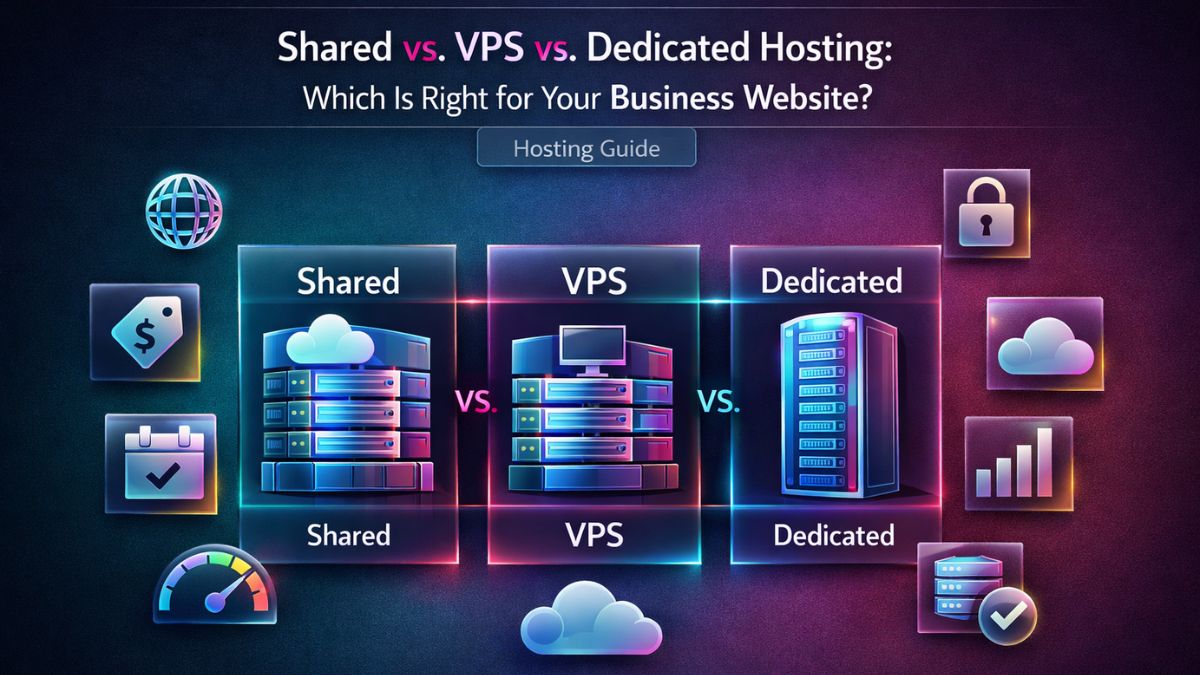
These three hosting types are not versions of the same product at different price points. They represent fundamentally different approaches to server resource allocation, security, and control. Here is what each one means in practical terms.
Shared Hosting: What It Is and Who It Fits
Shared hosting places your website on a physical server alongside dozens or hundreds of other websites, all drawing from the same pool of CPU, RAM, and bandwidth. It is the most affordable entry point for business website hosting, with plans typically ranging from $3 to $15 per month.
The core limitation is resource competition. When another site on your shared server experiences a traffic surge, your site slows down too — even if you did nothing wrong. For a new business with low traffic, a simple blog, or an informational site that does not process transactions, shared hosting can be a perfectly adequate starting point.
What shared hosting does not support reliably:
- High-traffic business or ecommerce websites
- Sites handling sensitive customer data
- WordPress sites with multiple active plugins under real traffic load
- Any business where downtime translates directly to revenue loss
VPS Hosting for Small Business: The Middle Ground
A Virtual Private Server (VPS) uses virtualization technology to partition a physical server into isolated environments. Each VPS gets a guaranteed allocation of CPU, RAM, and storage — resources that other users cannot consume. This makes VPS hosting for small business a meaningful step up in both performance and security.
VPS hosting gives you root-level access to your environment, which means you can install custom software, configure server settings, and manage resources in ways that shared hosting simply does not allow. Managed VPS hosting options handle those technical tasks on your behalf, which makes VPS viable even for business owners without a dedicated IT team.
Cloud VPS hosting for business takes this further by distributing your virtual server across multiple physical machines, which adds redundancy. If one physical node fails, your site stays online because the workload shifts automatically. For growing businesses that cannot afford unplanned downtime, cloud VPS is a practical and cost-effective architecture.
Dedicated Server Hosting for Business: Full Resource Control
Dedicated hosting gives your business exclusive access to an entire physical server. No resource sharing, no neighbor effect, no virtualization overhead. Every CPU cycle and every gigabyte of RAM belongs to your site and your site alone.
This is the appropriate choice for high-traffic business websites, large ecommerce platforms, and enterprise applications where performance consistency and security isolation are non-negotiable. Managed dedicated hosting means the provider handles server-level maintenance, security patching, and hardware monitoring — so your team focuses on the business, not the infrastructure.
The cost reflects the exclusivity. Dedicated hosting plans typically start around $80 per month and scale to several hundred dollars or more depending on hardware specifications and managed service levels. For businesses generating meaningful revenue through their website, this cost is justified by the performance gains, uptime reliability, and security posture that dedicated infrastructure provides.
Cloud Hosting: The Scalable Alternative Worth Knowing
Cloud hosting distributes your website across a network of interconnected servers rather than running it on a single machine. You pay for resources you actually use, and the infrastructure scales up or down based on real-time demand. This makes scalable cloud hosting for business websites one of the most flexible options available in 2026.
Cloud hosting sits in a category of its own — not purely shared, VPS, or dedicated — but it draws from the same principles. Many businesses moving off shared hosting choose cloud-based solutions rather than traditional VPS or dedicated plans because of the pay-as-you-go pricing model and the built-in redundancy that comes with distributed architecture.
Comparing Hosting Types Side by Side: Performance, Security, and Cost
Understanding each hosting type individually is useful. Comparing them directly against real business requirements is where the decision actually gets made. Here is how shared, VPS, and dedicated hosting stack up across the factors that matter most to business owners.
Website Speed and Performance
Shared hosting delivers acceptable performance only when traffic is low and server load is light. Under real business traffic conditions — especially for WordPress business hosting with active plugins, WooCommerce stores, or image-heavy service sites — shared environments show their limits quickly. Page load times creep past two seconds, and performance becomes inconsistent.
VPS hosting delivers reliably faster performance because your allocated resources are not at the mercy of other tenants. For most growing businesses, a properly configured managed VPS will hit load time benchmarks that satisfy both Google's Core Web Vitals and real user expectations. The key phrase is "properly configured" — an underpowered or poorly tuned VPS can perform just as badly as shared hosting.
Dedicated hosting delivers the highest and most consistent performance ceiling of any single-server option. For businesses running high-traffic websites, large product catalogs, or resource-intensive web applications, dedicated infrastructure removes the variables that cause performance degradation on shared or entry-level VPS environments.
Security and Data Protection
Shared hosting carries an inherent security risk that no amount of good password hygiene fully eliminates. If another site on your shared server is compromised, the blast radius can reach your site through shared system resources. Business hosting with malware protection at the shared level typically means scanning, not true isolation — the architecture itself limits how protected you can be.
VPS environments provide genuine isolation. Your files, processes, and network traffic operate in a contained environment separate from all other VPS tenants on the same physical machine. Business hosting with security features at the VPS level can include firewalls, intrusion detection, and full SSL certificate management configured specifically to your environment.
Dedicated hosting offers the highest level of security isolation available in traditional hosting infrastructure. With no shared server environment to worry about, security hardening can be applied comprehensively at every layer — operating system, application, and network. For businesses handling sensitive customer data, payment information, or proprietary content, dedicated infrastructure is the appropriate baseline.
Scalability and Growth Readiness
Shared hosting does not scale in any meaningful sense. When you outgrow it, you migrate — there is no in-place upgrade path that preserves your performance under increased demand.
VPS hosting scales within defined limits. Most managed VPS providers allow you to add RAM, CPU, or storage without migrating your site to a new server, which reduces downtime and operational friction. This makes VPS the practical choice for scalable website hosting for businesses that are growing steadily but have not yet reached the traffic volumes that justify dedicated infrastructure.
Dedicated hosting and cloud hosting offer the highest scalability ceiling, but through different mechanisms. Dedicated servers scale by hardware upgrade or additional server provisioning. Cloud hosting scales dynamically by drawing on additional distributed resources on demand — which is why scalable cloud hosting for business websites has become a popular choice among businesses with unpredictable or seasonal traffic patterns.
Pricing: What You Actually Pay Across Each Tier
The price difference between these hosting types is real, but so is the performance difference. Here is a practical range for 2026:
- Shared Hosting: $3 to $15 per month. Appropriate for informational sites, early-stage startups, and low-traffic blogs.
- VPS Hosting: $20 to $100 per month for unmanaged plans. Managed VPS hosting ranges from $50 to $250 per month depending on resources and support level.
- Dedicated Hosting: $80 to $500+ per month. Managed dedicated hosting at the enterprise level can exceed $1,000 per month for fully supported, high-specification configurations.
- Cloud Hosting: Variable, based on usage. Starting costs are often comparable to VPS, but scale with actual resource consumption.
Low-cost VPS hosting for business at the $20 to $40 range exists, but it typically means unmanaged environments where you handle configuration, security, and troubleshooting yourself. For most business owners without a dedicated server administrator, managed plans are worth the additional monthly cost.
Hosting Trends Shaping Business Infrastructure Decisions in 2026
The hosting landscape has shifted considerably. Several developments are directly influencing which hosting types businesses choose and how providers package their offerings.
Performance Expectations Have Increased
Google's ongoing Core Web Vitals updates have made page speed and server response time measurable ranking factors, not just user experience considerations. This has accelerated the migration of small businesses away from shared hosting toward VPS and cloud environments. Fast-loading business hosting is no longer a premium feature — it is a baseline requirement for competitive search visibility.
Businesses running SEO campaigns particularly feel this pressure. SEO-friendly web hosting — meaning hosting that delivers fast TTFB (Time to First Byte), consistent uptime, and reliable server response — is now a prerequisite for any business investing meaningfully in organic search traffic.
Managed Hosting Adoption Is Growing Rapidly
Business owners increasingly want the performance of VPS or dedicated environments without the administrative burden of managing them. Managed VPS hosting and managed dedicated hosting have grown in demand as providers respond with more comprehensive service bundles that include security patching, performance tuning, daily backups, and 24/7 monitoring as standard inclusions.
This trend reflects a broader shift in how businesses think about hosting: not as a pure infrastructure commodity, but as a managed service with defined performance and support expectations.
Green and Sustainable Hosting Is Gaining Traction
Green web hosting for businesses — powered by renewable energy or carbon offset programs — has moved from a niche preference to a visible differentiator. For businesses with sustainability commitments or clients who value environmental responsibility, hosting provider energy practices are now part of the vendor evaluation process.
Several major providers have published verifiable green energy commitments, and the certification landscape for sustainable hosting has matured enough to make meaningful comparisons possible.
Best Practices for Choosing the Right Business Website Hosting
These recommendations come from working with real businesses across multiple industries and seeing firsthand where hosting decisions either support growth or constrain it.
1. Match Your Hosting Type to Your Current Traffic, Not Your Future Aspirations
Start with an honest assessment of your actual monthly visitors, not the traffic you hope to have in two years. A startup with under 5,000 monthly visitors does not need dedicated hosting — but a business processing 50,000 monthly visitors on shared hosting is already operating in a risk zone. Use Google Analytics or your current host's traffic data to make this decision with real numbers, not estimates.
2. Prioritize Managed Plans If You Do Not Have a Server Administrator
Unmanaged VPS or dedicated hosting requires someone who knows how to configure Linux environments, set up firewalls, manage software packages, and respond to security incidents. If that person does not exist on your team, an unmanaged plan is not a cost saving — it is a liability. Managed VPS hosting at $100 to $150 per month is far less expensive than the cost of a single security incident on an improperly secured server.
3. Verify Uptime Guarantees and Check Historical Performance
Any reputable business hosting provider will publish a Service Level Agreement (SLA) with an uptime guarantee — typically 99.9% or higher. Before committing, search for independent uptime monitoring reports on the provider using tools like UptimeRobot or StatusCake reviews. A 99.9% uptime guarantee translates to approximately 8.7 hours of potential downtime per year. For ecommerce business hosting where every hour offline has a direct revenue cost, 99.99% SLAs are worth the premium.
4. Confirm That Daily Backups Are Included and Independently Stored
Business hosting with daily backups sounds standard until you read the fine print. Some providers include backups but store them on the same server as your site — which means a server-level failure destroys both your live site and your backup simultaneously. Confirm that backups are stored on separate infrastructure, ask how long they are retained, and verify the restoration process before you need it.
5. Test Server Response Time Before Committing to a Long-Term Plan
Use a tool like GTmetrix or Pingdom to test the server response time of a provider's demo or test environment before signing a contract. Target a Time to First Byte (TTFB) under 200 milliseconds for a well-optimized server. Anything consistently above 600ms is a performance problem waiting to affect your search rankings and user experience. Many providers offer 30-day money-back guarantees — use that window to run real performance benchmarks on your actual site files before committing long-term.
Common Mistakes to Avoid When Selecting Business Website Hosting
These are not theoretical risks. These are decisions that business owners make regularly and regret — often after a costly incident or migration project.
Staying on Shared Hosting Too Long
Shared hosting is a starting point, not a permanent infrastructure strategy. Businesses that keep growing without upgrading their hosting plan eventually experience slow load times, intermittent downtime during peak hours, and security exposures they did not create themselves. The warning signs are gradual — slightly slower pages, occasional timeout errors — and easy to rationalize until a major performance failure makes the problem impossible to ignore.
Correction: Set a traffic threshold as your upgrade trigger. When your site consistently exceeds 10,000 monthly visits or your bounce rate starts climbing without a clear content reason, treat it as a signal to evaluate VPS or cloud hosting options immediately.
Choosing Unmanaged Hosting to Save Money Without the Expertise to Support It
An unmanaged VPS at $20 per month looks like a smart cost decision on paper. Without server administration knowledge, it becomes a vulnerability. Unmanaged environments require manual security patching, firewall configuration, and software management. A single missed security update on an unmanaged server can result in a full site compromise, data loss, and recovery costs that dwarf years of managed hosting fees.
Correction: If your team does not include someone with active Linux server management experience, choose a managed hosting plan. The support cost is an operational necessity, not an optional upgrade.
Not Testing Migration Before Going Live on a New Host
Business hosting migration services exist because moving a website between hosts is not a copy-paste operation. Database configurations, file permissions, SSL certificates, email routing, and DNS propagation all require careful management. Businesses that migrate without testing on a staging environment first regularly experience broken functionality, missing content, or extended downtime during the transition.
Correction: Any credible managed hosting provider will offer a staging migration where your site is fully transferred and tested before the DNS switch. Insist on this process regardless of how straightforward the migration appears.
Ignoring Geographic Server Location Relative to Your Audience
Hosting a United States-based business website on a server located in Europe or Asia adds measurable latency to every page load for your domestic visitors. This directly affects both user experience and local SEO performance. Many business owners select a provider without checking where the physical servers are located.
Correction: Confirm the data center locations your provider offers before signing up. For businesses serving U.S. customers, choose a provider with primary data centers in the continental United States. If you have international traffic, a CDN (Content Delivery Network) can distribute static assets globally without requiring you to change your primary hosting environment.
Frequently Asked Questions About Business Website Hosting
What is the difference between shared, VPS, and dedicated hosting?
Shared hosting places your site on a server with many others, sharing all resources. VPS hosting gives you a dedicated partition of a physical server with guaranteed resources. Dedicated hosting gives your business exclusive access to an entire server. Each tier delivers progressively more performance, control, and security — at a higher cost. The right choice for business website hosting depends on your traffic volume, security needs, and budget.
How do I know when to upgrade from shared hosting to VPS?
The clearest signals are consistent slow load times, recurring downtime during peak traffic hours, or a growing ecommerce or lead generation operation where site reliability directly affects revenue. If your site regularly exceeds 10,000 monthly visitors and you are on a shared plan, performance degradation is likely already occurring. Moving to VPS hosting for small business at that stage typically produces an immediate and measurable improvement in load speed and stability.
How much does business website hosting cost per month?
Shared hosting runs $3 to $15 per month. Managed VPS hosting ranges from $50 to $250 per month depending on resources and support level. Dedicated server hosting for business starts around $80 per month and scales to $500 or more for high-specification managed configurations. Cloud hosting costs vary with usage but generally starts at pricing comparable to VPS. The right investment level depends on how much your business depends on the website for revenue.
Is VPS hosting secure enough for an ecommerce business?
Yes — when properly configured, a managed VPS with active security monitoring, a web application firewall, SSL certificate management, and regular patching meets the security requirements for most ecommerce operations. For businesses processing high transaction volumes or storing large volumes of sensitive customer data, dedicated server hosting provides a higher level of isolation. The key factor is whether the hosting environment includes active security management, not just the server type alone.
What is managed hosting and do I need it?
Managed hosting means the provider handles server-level administration on your behalf — including security updates, performance tuning, backups, and monitoring. You get the performance of a VPS or dedicated environment without needing to manage the underlying infrastructure yourself. Most business owners without a dedicated IT team need managed hosting. The alternative — unmanaged hosting — requires active server administration knowledge that most businesses simply do not have in-house.
Does hosting type affect SEO and search rankings?
Yes, directly. Page speed, uptime, and server response time are factors that Google measures and uses in ranking decisions. A slow shared hosting environment with frequent downtime will underperform against a well-configured VPS or cloud setup in organic search results over time. SEO-friendly web hosting means fast TTFB, consistent 99.9%+ uptime, and a server configuration that supports modern performance standards including HTTP/2 and compression. Hosting is the infrastructure layer that SEO performance is built on.
The hosting decision is not a minor administrative detail — it is a foundational business infrastructure choice that affects every visitor, every transaction, and every search ranking your site achieves. Shared hosting works as a starting point. VPS hosting handles the growth phase for most small and mid-sized businesses. Dedicated and cloud hosting serve businesses where performance consistency and security are non-negotiable requirements. Choosing the right business website hosting from the start — or upgrading at the right time — is one of the highest-return operational decisions a business owner can make. If you are unsure which environment fits your current needs, talking with an experienced website management team will get you to a clear, defensible answer far faster than working through it alone.
Schedule an Appointment with BlackTech Consultancy
Choosing the right hosting environment is only part of the equation — how your site is configured, secured, and maintained on that infrastructure determines the real-world results. If you want an expert review of your current setup or guidance on the right hosting path for your business, the team at BlackTech Consultancy is ready to help.
BlackTech Consultancy
Virginia, United States
+1 571-478-2431
info@blacktechcorp.com
https://www.blacktechcorp.com/
Our team works with businesses across Virginia and the United States to deliver results-driven technology and digital marketing solutions. Contact us today to get started.