
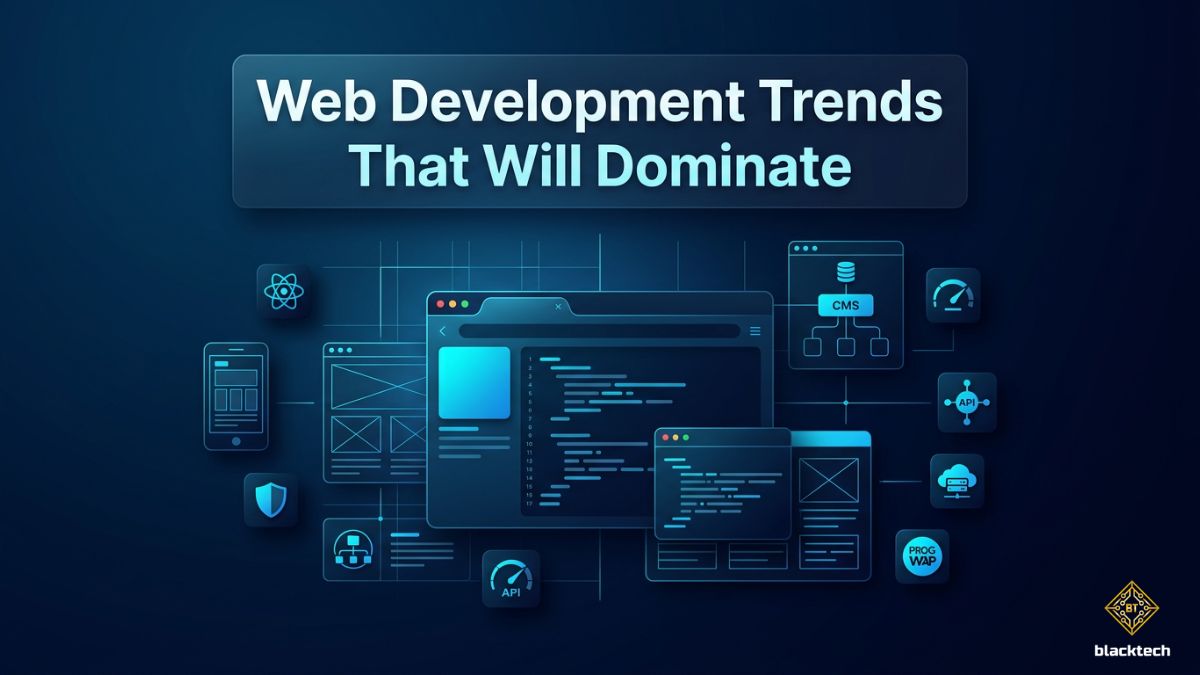
Over 70% of consumers judge a company's credibility based on its website. That number has not changed much over the years — but the standards behind what makes a website credible absolutely have. Web development in 2026 is no longer just about putting pages online. It is about building fast, secure, accessible, and intelligent digital experiences that match what users now expect as a baseline. Businesses that treat their website as a one-time project rather than a strategic asset are already falling behind. The gap between companies that invest in modern web development and those that do not is becoming impossible to ignore — and that gap is widening every quarter.
What Is Web Development and Why It Matters
Web development refers to the process of building and maintaining websites and web applications — covering everything from the visual design and user interface on the front end, to the servers, databases, and application logic that power the back end. It is the technical foundation behind every functional, performant website on the internet.
According to Statista, the global web development market is projected to exceed $89 billion by 2026, driven by the accelerating demand for digital-first business infrastructure. That figure reflects how central the web has become to commerce, communication, and customer experience across every industry sector.
For businesses, the stakes are direct and measurable. A poorly built website costs you traffic, leads, and sales — often without you knowing why. Page speed, mobile compatibility, security, and accessibility are no longer optional features reserved for enterprise companies. They are requirements that affect how Google ranks your site and how users decide whether to trust you. Understanding where web development is heading in 2026 is not a technical exercise — it is a business strategy decision.
Key Web Development Trends Shaping 2026
Trends Redefining How Websites Are Built and Experienced
The web is changing structurally — not just visually. The trends below are not experimental; they are actively being adopted by forward-thinking businesses right now, and they will define competitive digital performance through 2026 and beyond.
AI-Assisted Development Is Becoming Standard Practice
Artificial intelligence is no longer sitting on the edges of web development — it is embedded in the workflow. Development tools now assist with code generation, automated testing, error detection, and performance recommendations. Developers using AI-assisted environments are completing projects faster and with fewer bugs, which directly impacts project costs and timelines for clients.
For businesses, this means more efficient builds, lower long-term maintenance overhead, and faster turnaround on updates and feature additions. The quality bar has risen because the tools available to skilled developers have gotten significantly better.
Progressive Web Apps Are Replacing Traditional Mobile Sites
Progressive Web Apps (PWAs) bridge the gap between mobile websites and native mobile applications. They load fast, work offline, send push notifications, and can be installed directly on a device's home screen — all without requiring an app store listing.
For small and mid-sized businesses, PWAs represent one of the most practical advancements in mobile-first web development. Instead of maintaining a separate mobile app budget, companies can build a single PWA that performs across all devices. Retailers, restaurants, service businesses, and media companies are all seeing measurable improvements in engagement and return visits after migrating to progressive web app architecture.
Headless CMS Architecture Is Taking Over Content-Driven Websites
A headless CMS separates the content management back end from the front-end presentation layer, allowing content to be delivered via APIs to any channel — website, app, kiosk, or smart device. This is one of the most significant backend development trends of 2026 because it gives businesses genuine flexibility over how content is displayed and reused across platforms.
Platforms like Contentful, Sanity, and Storyblok are seeing sharp adoption increases. For businesses running content marketing, ecommerce, or multi-channel campaigns, headless CMS architecture reduces duplication of effort and makes it significantly easier to update and repurpose content without developer dependency at every step.
No-Code and Low-Code Platforms Are Expanding Business Capabilities
No-code and low-code platforms have matured considerably. Tools like Webflow, Bubble, and OutSystems now allow non-technical users to build functional, professional-grade web applications and sites — while also serving as rapid prototyping environments for professional development teams.
For small businesses with limited budgets, these platforms offer genuine value. They reduce the time and cost of getting a functional site live. However, it is important to understand their limits: complex integrations, custom functionality, high-traffic scalability, and advanced security requirements still demand professional custom web development. The smartest approach for most businesses is using low-code tools for speed and iteration while engaging professional developers for the layers that require technical depth.
Web Accessibility Is No Longer Optional — It Is a Legal Standard
Web accessibility has moved from a best-practice recommendation to a legal requirement for many organizations in the United States. Section 508 compliance and WCAG 2.1/2.2 guidelines are now referenced in active lawsuits and regulatory audits across industries. Inaccessible websites face real legal exposure, not just poor user experience outcomes.
From a development standpoint, building for accessibility in 2026 means proper semantic HTML structure, keyboard navigation support, screen reader compatibility, sufficient color contrast ratios, and alternative text for all non-text content. Businesses in government contracting, healthcare, education, and finance have the most immediate compliance pressure — but accessibility improvements benefit all users and also improve SEO performance.
API-Driven Development Is Powering the Modern Web Stack
API-driven web development — where the front end communicates with various back-end services through APIs rather than a monolithic architecture — has become the dominant approach for building scalable, modern websites. This model allows businesses to integrate payment systems, CRMs, marketing tools, analytics platforms, and third-party data sources without rebuilding from scratch each time.
The rise of API-first development directly supports faster feature deployment and easier third-party integrations. For ecommerce businesses in particular, this model supports complex workflows — inventory management, order tracking, customer accounts, and dynamic pricing — that a traditional site structure would struggle to handle at scale.
Website Performance Optimization Is a Core Development Priority
Google's Core Web Vitals have been part of the ranking algorithm for years, but 2026 brings sharper performance thresholds and increased user expectations. Largest Contentful Paint (LCP), Interaction to Next Paint (INP), and Cumulative Layout Shift (CLS) are now measurable benchmarks that businesses need to monitor actively — not check once and forget.
Performance optimization techniques like image compression with next-gen formats (WebP, AVIF), lazy loading, CDN delivery, code splitting, and server-side rendering are now standard practice in professional web development. A one-second delay in page load time can reduce conversions by up to 7%, according to research from Akamai. That statistic alone makes website speed optimization a business priority, not just a technical one.
Secure Web Development Practices Are Non-Negotiable
Cyber threats targeting websites have grown more sophisticated. SQL injection, cross-site scripting, API vulnerabilities, and supply chain attacks through third-party scripts are all active threats in 2026. Secure web development practices — including HTTPS enforcement, input validation, dependency auditing, Content Security Policies (CSP), and regular security testing — are expected in every professional build.
For businesses collecting customer data, processing payments, or running authenticated portals, security is directly tied to legal liability and brand trust. A single breach can erase years of earned customer confidence. Integrating security from the start of the development process — rather than patching vulnerabilities after launch — is the only approach that actually works at scale.
Best Practices for Web Development
Proven Web Development Strategies That Work in 2026
These are not general recommendations. These are the specific practices that professional development teams apply to client projects that consistently outperform industry benchmarks.
1. Audit your current site's Core Web Vitals before making any major changes.
Before redesigning or rebuilding, run your existing site through Google PageSpeed Insights and Search Console's Core Web Vitals report. This tells you exactly where performance is failing — LCP, INP, or CLS — so development effort targets real problems rather than cosmetic improvements. Many businesses waste significant budget on redesigns when their core issue is a slow server or uncompressed images.
2. Adopt a mobile-first development approach — not just responsive design.
Mobile-first means designing and coding for the smallest screen first, then scaling up — not the other way around. Over 60% of web traffic globally comes from mobile devices. Building for desktop and adapting down always produces inferior mobile experiences. Start with mobile constraints and you end up with a faster, cleaner product across every device.
3. Implement structured data markup on every key page.
Schema markup — the structured data that tells search engines what your content means — is one of the most underused SEO-friendly web development practices available. Adding schema for business information, reviews, services, FAQs, and events improves your eligibility for rich results in Google Search, which directly impacts click-through rates. Tools like Google's Rich Results Test make validation straightforward.
4. Use a component-based front-end architecture for scalable design systems.
Frameworks like React, Vue, or Svelte, combined with a design system of reusable components, allow your team to update the website consistently and efficiently over time. When a button style, form layout, or card component needs to change, it updates everywhere at once. This prevents the design inconsistency that accumulates on older, traditionally-built sites and reduces long-term maintenance cost significantly.
5. Plan for third-party script management from day one.
Analytics tools, chat widgets, ad pixels, and social media embeds all add JavaScript to your pages. Unmanaged, these scripts are one of the top causes of slow load times and privacy compliance issues. Implement a tag management system like Google Tag Manager, audit scripts quarterly, and load non-essential scripts asynchronously. This single discipline can recover 0.5–1.5 seconds of load time on many business websites.
Common Mistakes Businesses Make With Web Development in 2026
Web Development Errors That Cost Real Money and Rankings
These are mistakes that appear repeatedly across client projects — and each one has direct, measurable consequences.
Mistake 1: Treating the website launch as the finish line.
A website that goes live and receives no further attention will degrade in performance, security, and relevance within months. Core Web Vitals shift as third-party tools are added. Security vulnerabilities emerge in outdated plugins and dependencies. Content becomes stale. The correction is straightforward: establish a quarterly website maintenance schedule that covers performance auditing, security updates, content review, and analytics reporting.
Mistake 2: Ignoring accessibility during the build — then scrambling to retrofit it.
Adding accessibility features after a website is built is significantly more expensive than building them in from the start. Retrofitting color contrast, keyboard navigation, and ARIA labels across an existing codebase takes far longer than designing with those requirements in mind. For businesses with federal contracts or working in regulated industries, the legal risk of non-compliance makes this far more than a development preference.
Mistake 3: Choosing a platform based on price alone.
Budget matters — but selecting a CMS or development framework purely because it is cheapest upfront frequently results in higher total costs over time. Platforms that limit customization, have poor hosting performance, or lack developer support create recurring bottlenecks as the business grows. Evaluate platforms based on scalability, security track record, and the availability of skilled developers who work with them professionally.
Mistake 4: Building without a defined conversion goal per page.
Every page on a business website should have one clear action it is designed to drive — a form submission, a phone call, a purchase, or a content download. When developers build pages without a defined conversion goal provided by the client, layouts default to generic structures that distribute attention instead of focusing it. Before any development begins, map out the intended user action for each key page and build around that goal.
Frequently Asked Questions About Web Development Trends in 2026
What is web development and how is it different from web design?
Web development refers to the technical process of building a website — writing code, connecting databases, configuring servers, and implementing functionality. Web design focuses on the visual and user experience side — layout, typography, color, and interaction design. In practice, modern projects require both disciplines working together. A well-designed site that is poorly built will be slow, insecure, and hard to maintain. Strong web development ensures the design actually performs as intended.
How do progressive web apps differ from regular websites?
Progressive web apps (PWAs) are built using web technologies but behave more like native mobile apps. They can work offline through service workers, load faster than standard mobile sites, support push notifications, and can be installed on a device's home screen without going through an app store. For businesses with high mobile traffic, PWAs offer significantly better engagement metrics than a standard responsive website, often at a lower cost than building a separate native app.
How much does professional custom website development cost in 2026?
Custom website development costs vary widely based on scope, functionality, and the development team's expertise. A professional small business website typically ranges from $3,000 to $15,000. Ecommerce sites with custom integrations, membership portals, or complex backend logic can run $20,000 to $100,000 or more. The cost reflects not just the build but also the architecture decisions that determine how well the site performs, scales, and stays secure over time. Low-cost template builds often create larger expenses down the line through performance issues and limited flexibility.
What are the most important web development trends for small businesses in 2026?
For small businesses, the highest-impact web development priorities in 2026 are mobile-first performance, Core Web Vitals optimization, accessibility compliance, and structured data implementation. These are areas where professional investment directly affects search rankings and user trust. Low-code platforms like Webflow are viable for straightforward sites, but businesses with custom service workflows, ecommerce needs, or growing traffic requirements benefit most from custom web development solutions tailored to their specific goals.
How does web development affect SEO performance?
Web development and SEO are directly connected. Site speed, mobile responsiveness, URL structure, crawlability, schema markup, and secure HTTPS delivery are all technical SEO factors that are controlled entirely at the development level. A site built without SEO-friendly web development practices will underperform in search regardless of content quality. The most effective SEO outcomes come from development teams that treat technical SEO as a core part of the build process — not something added after the site goes live.
How often should a business update or rebuild its website?
Most business websites benefit from a meaningful redesign or architectural update every 3 to 4 years, with ongoing performance and content updates happening quarterly or monthly. Technology moves fast enough that a 5-year-old website is often running on outdated frameworks, missing accessibility features, and failing modern performance benchmarks. More importantly, user expectations change. A site that felt professional in 2021 may now communicate outdated credibility to a first-time visitor in 2026. Regular investment in website improvement is more cost-effective than large infrequent rebuilds.
Schedule an Appointment with BlackTech Consultancy
If your website is not keeping pace with where web development is heading in 2026, the right professional guidance can make a significant difference — in performance, search rankings, and the results your site actually delivers.
BlackTech Consultancy
Virginia, United States
+1 571-478-2431
info@blacktechcorp.com
https://www.blacktechcorp.com/